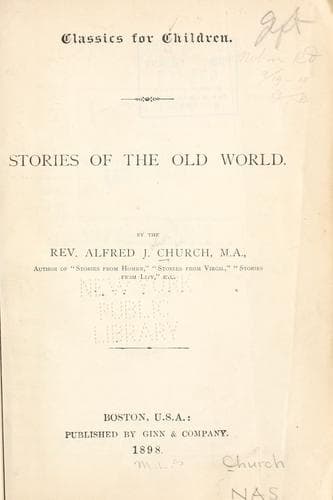
Mythology, Greek -- Juvenile literature; Mythology, Roman -- Juvenile literature
So on the morning of the twelfth day they set sail, and a strong
west wind blew from behind and carried them quickly over the sea.
But when they came to the tomb of Sthenelus they beheld a marvellous
sight. Now this Sthenelus was companion to Hercules in battling with
the Amazons, and had been wounded with an arrow, and so died. And he
besought Persephone, that is Queen of the dead, that he might look upon
the heroes; and when she consented, he stood upon the top of his tomb
equipped as one that went forth to battle, with a fair four-crested
helmet on his head. Much did the heroes marvel to behold him. But
Mopsus, the seer, bade them tarry and make offerings to the dead.
Wherefore they landed and built an altar, and offered sacrifices, and
Orpheus also dedicated his harp for a gift. After this they departed,
and sailed by the river of Parthenius, which is by interpretation the
Virgin River; so men call it, because Artemis the Virgin, the daughter
of Latona, is wont to bathe therein when she is weary with hunting.
Also they passed the river of Thermodon, and tarried not, for such was
the will of Zeus, that they might not join battle with the Amazons
who dwelt in these parts, a fierce race and delighting in war. Surely
not without much bloodshed and damage to both such battle had been.
The next day they came to the land of the Chalybes. These care not to
plough the land with oxen, or to plant seed or to reap harvests; nor
have they flocks or herds; but they dig iron out of the earth, and
change it with other men for food. Never doth morning come, but it
seeth them at their toil, where they labor without ceasing in the midst
of reek and smoke. But after the Chalybes they came to the Mossyni, a
strange folk that are contrary to other men, doing abroad what others
do at home, and at home what others do abroad. Their king also sitteth
all day on his throne, and judgeth his people; nor, indeed, is he to
be envied for all his royal state, seeing that if he err at all in
his judgment the people shut him in prison till he die of hunger.
Next they came to the island of Aretias, wherefrom as they sailed in
the twilight there came a great bird flying over them, and shooting a
sharp-pointed feather from its wing. And the feather struck Oïleus on
his left shoulder and wounded him, so that he dropped the oar from his
hand. After this came other like birds also; and though the heroes shot
at them with arrows and slew certain of them, yet could they not drive
them away. Then said Amphidamas to his companions: “We are come to the
island of Aretias, and I judge that we shall not prevail over these
birds with our arrows. For Hercules prevailed not thus over the birds
of the Lake Stymphalus, as I saw with my own eyes. Do ye, therefore,
as I bid you. Put ye on your helmets, and let some of you row with the
oars, and let the rest so order their spears and their shields that
they may be a covering to the ship. Shout also with all your might; and
Public-domain text, read in full here on John Shaqi.
Reviews
Reviews
No reviews yet
Be the first to share your thoughts on this work.
Join the Discussion
Join the discussion
Sign in to leave a comment or review.
Sign InorCreate an account