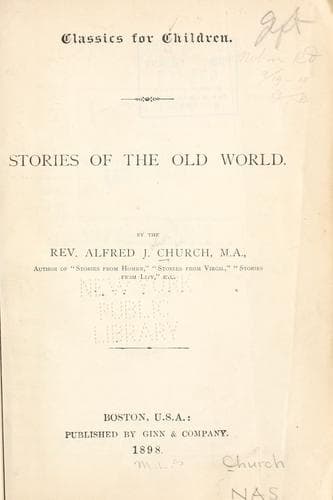
Mythology, Greek -- Juvenile literature; Mythology, Roman -- Juvenile literature
After this they heard a great wailing of infants, even the voices of
such as are taken away before they have had lot or part in life. And
near to these were such as have died by false accusation; yet lack they
not justice, for Minos trieth their cause. And yet beyond, they that,
being guiltless, have laid hands upon themselves. Fain would they now
endure hardships, being yet alive, but may not, for the river keeps
them in with his unlovely stream as in a prison. Not far from these are
the Mourning Fields, where dwell the souls of those that have died of
love, as Procris, whom Cephalus slew in error, and Laodamia, who died
of grief for her husband. And among these was Dido, fresh from the
wound wherewith she slew herself. And when Æneas saw her darkly through
the shadows, even as one who sees, or thinketh that he sees, the new
moon lately risen, he wept, and said, “O Dido, it was truth, then, that
they told me, saying that thou hadst slain thyself with the sword.
Tell me, Was I the cause of thy death? Loath was I, O Queen--I swear it
by all that is most holy in heaven or hell--to leave thy land. But the
gods, at whose bidding I come hither this day, constrained me; nor did
I think that thou wouldst take such sorrow from my departure. But stay;
depart not; for never again may I speak to thee but this once only.”
So he spake, and would fain have appeased her wrath. But she cast her
eyes to the ground, and her heart was hard against him, even as a rock.
And she departed into a grove that was hard by, wherein was her first
husband, Sichæus, who loved her even as he was loved. After this they
came to the land where the heroes dwell. And there they saw Tydeus,
who died before Thebes; and Adrastus, and also many men of Troy, as
the three sons of Antenor, and Idæus who was the armor-bearer of King
Priam, and bare the arms and drave the chariot yet. All these gathered
about him, and would fain know wherefore he had come. But when the
hosts of Agamemnon saw his shining arms through the darkness, they
fled, as in old days they had fled to the ships; and some would have
cried aloud, but could not, so thin are the voices of the dead.
Among these he saw Deïphobus, son of Priam. Cruelly mangled was he, for
his hands had been cut off, and his ears and his nostrils likewise.
Scarce did Æneas know him, and he himself in shame would have hidden
his wounds; but the son of Anchises spake to him, saying, “Who hath
dealt so foully with thee, great Deïphobus? Men told me that on the
last night of Troy thou didst fall dead on a heap of Greeks whom thou
hadst slain. Wherefore I built thee a tomb by the sea, and thrice
called aloud thy name. But thee I found not, that I might lay thee
therein.”
Public-domain text, read in full here on John Shaqi.
Reviews
Reviews
No reviews yet
Be the first to share your thoughts on this work.
Elsewhere in the archive
Join the Discussion
Join the discussion
Sign in to leave a comment or review.
Sign InorCreate an account