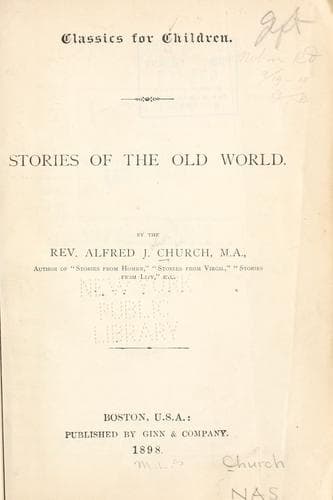
Mythology, Greek -- Juvenile literature; Mythology, Roman -- Juvenile literature
Then Deïphobus made answer: “Thou hast left nothing undone, but hast
paid me all due honor. But my ill fate and the accursed wickedness of
the Spartan woman have destroyed me. How we spent that last night in
idle rejoicings thou knowest. And she, while the women of Troy danced
before the gods, stood holding a torch on the citadel, as though she
were their leader, yet in truth she called therewith the Greeks from
Tenedos. But I lay overcome with weariness in my chamber. Then did
she, a noble wife, forsooth! take all the arms out of the house, and
my trusty sword also from under my head; and after brought thereunto
Menelaüs, so hoping to do away her sin against him; and Ulysses also,
always ready with evil counsels. What need of more? May the gods do so
and more also to them. But tell me why hast thou come hither?”
And it was now past noonday, and the two had spent in talk all the
allotted time. Therefore the Sibyl spake: “Night cometh, Æneas, and we
waste the day in tears. Lo! here are two roads. This on the right hand
leadeth to the palace of Pluto and to the Elysian plains; and that on
the left to Tartarus, the abode of the wicked.” And Deïphobus answered:
“Be not wroth, great priestess; I depart to my own place. Do thou, my
friend, go on and prosper.”
But as Æneas looked round he saw a great building, and a three-fold
wall about it, and round the wall a river of fire. Great gates there
were, and a tower of brass, and the fury Tisiphone sat as warder. Also
he heard the sound of those that smote upon an anvil, and the clanking
of chains. And he stood, and said, “What mean these things that I see
and hear?” Then the Sibyl made answer: “The foot of the righteous may
not pass that threshold. But when the Queen of hell gave me this
office she herself led me through the place and told me all. There
sitteth Rhadamanthus the Cretan, and judgeth the dead. And them that
be condemned Tisiphone taketh, and the gate which thou seest openeth
to receive them. And within is a great pit, and the depth thereof is
as the height of heaven. Herein lie the Titans, the sons of Earth,
whom Jupiter smote with the thunder; and herein the sons of Aloeus,
who strove to thrust the gods from heaven; and Salmoneus, who would
have mocked the thunder of Jupiter, riding in his chariot through the
cities of Elis, and shaking a torch, and giving himself out to be a
god. But the lightning smote him in his pride. Also I saw Tityos,
spread over nine acres of ground, and the vulture feeding on his heart.
And over some hangs a great stone ready to fall; and some sit at the
banquet, but when they would eat, the Fury at their side forbids, and
rises and shakes her torch and thunders in their ears. These are they
who while they were yet alive hated their brothers, or struck father
or mother, or deceived one that trusted to them, or kept their riches
for themselves, nor cared for those of their own household (a great
multitude are they), or stirred up civil strife.
Public-domain text, read in full here on John Shaqi.
Reviews
Reviews
No reviews yet
Be the first to share your thoughts on this work.
Elsewhere in the archive
Join the Discussion
Join the discussion
Sign in to leave a comment or review.
Sign InorCreate an account