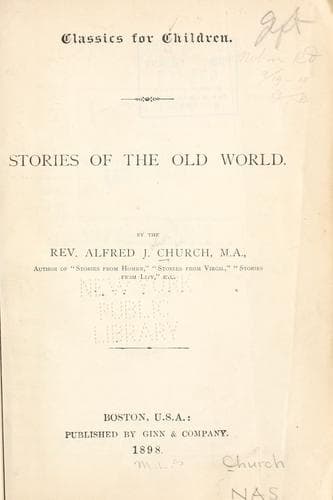
Mythology, Greek -- Juvenile literature; Mythology, Roman -- Juvenile literature
And he ran forward and cast his spear, smiting a man of Arcadia below
the belt, upon the groin. One of nine brothers was he, sons of a Tuscan
mother, but their father was a Greek; and they, when they saw him
slain, caught swords and spears, and ran forward. And straightway the
battle was begun. First they brake down the altars, that they might
take firebrands therefrom; and King Latinus fled from the place. Then
did Messapus drive his horses against King Aulestes of Mantua, who,
being fain to fly, stumbled upon the altar and fell headlong on the
ground. And Messapus smote him with a spear that was like a weaver’s
beam, saying, “This, of a truth, is a worthier victim.” After this
Coryneüs the Arcadian, when Ebysus would have smitten him, snatched a
brand from the altar and set fire to the beard of the man, and, before
he came to himself, caught him by the hair, and thrusting him to the
ground, so slew him. And when Podalirius pursued Alsus the shepherd,
and now held his sword over him ready to strike, the other turned, and
with a battle-axe cleft the man’s head from forehead to chin.
But all the while the righteous Æneas, having his head bare, and
holding neither spear nor sword, cried to the people, “What seek ye?
what madness is this? The covenant is established, and I only have
the right to do battle.” But even while he spake an arrow smote him,
wounding him. But who let it fly no man knoweth; for who, of a truth,
would boast that he had wounded Æneas? And he departed from the battle.
Now when Turnus saw that Æneas had departed from the battle he called
for his chariot. And when he had mounted thereon he drave it through
the host of the enemy, slaying many valiant heroes, as Sthenelus and
Pholus, and the two sons of Imbrasus the Lycian, Glaucus and Lades.
Then he saw Eumedes, son of that Dolon who would have spied out the
camp of the Greeks, asking as his reward the horses of Achilles (but
Diomed slew him). Him Turnus smote with a javelin from afar, and, when
he fell, came near and put his foot upon him, and taking his sword
drave it into his neck, saying, “Lo! now thou hast the land which thou
soughtest. Lie there, and measure out Italy for thyself.” Many others
he slew, for the army fled before him. Yet did one man, Phegeus by
name, stand against him, and would have stayed the chariot, catching
the bridles of the horses in his hand. But as he clung to the yoke and
was dragged along, Turnus broke his cuirass with his spear, and wounded
him. And when the man set his shield before him, and made at Turnus
with his sword, the wheels dashed him to the ground and Turnus struck
him between the helmet and the breast-plate, and smote off his head.
Public-domain text, read in full here on John Shaqi.
Reviews
Reviews
No reviews yet
Be the first to share your thoughts on this work.
Elsewhere in the archive
Join the Discussion
Join the discussion
Sign in to leave a comment or review.
Sign InorCreate an account