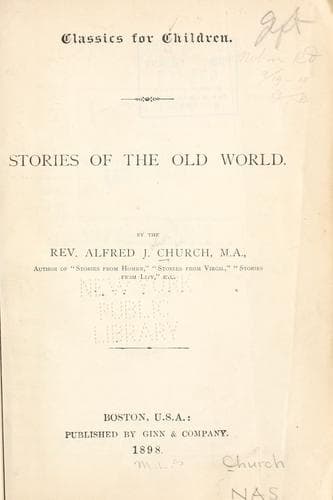
Mythology, Greek -- Juvenile literature; Mythology, Roman -- Juvenile literature
But in the meanwhile Mnestheus and Achates and Iülus led Æneas to the
camp, leaning on his spear. Very wrath was he and strove to draw forth
the arrow. And when he could not, he commanded that they should open
the wound with the knife, and so send him back to the battle. Iapis
also, the physician, ministered to him. Now this Iapis was dearer than
all other men to Apollo, and when the god would have given him all his
arts, even prophecy and music and archery, he chose rather to know the
virtues of herbs and the art of healing, that so he might prolong the
life of his father, who was even ready to die. This Iapis, then, having
his garments girt about him in healer’s fashion, would have drawn
forth the arrow with the pincers but could not. And while he strove,
the battle came nearer, and the sky was hidden by clouds of dust, and
javelins fell thick into the camp. But when Venus saw how grievously
her son was troubled, she brought from Ida, which is a mountain of
Crete, the herb dittany. A hairy stalk it hath and a purple flower. The
wild goats know it well if so be that they have been wounded by arrows.
This, then, Venus, having hidden her face, brought and dipped into the
water, and sprinkled there with ambrosia and sweet-smelling panacea.
And Iapis, unawares, applied the water that had been healed; and lo!
the pain was stayed and the blood was staunched, and the arrow came
forth, though no man drew it, and Æneas’s strength came back to him as
before. Then said Iapis, “Art of mine hath not healed thee, my son.
The gods call thee to thy work.” Then did Æneas arm himself again, and
when he had kissed Iülus and bidden him farewell, he went forth to the
battle. And all the chiefs went with him, and the men of Troy took
courage and drave back to the Latins. Then befell a great slaughter,
for Gyas slew Ufens who was the leader of the Æquians; also Tolumnius,
the great augur, was slain, who had first broken the covenant, slaying
a man with his spear. But Æneas deigned not to turn his hand against
any man, seeking only for Turnus, that he might fight with him. But
when the nymph Juturna perceived this she was sore afraid. Therefore
she came near to the chariot of her brother, and thrust out Metiscus,
his charioteer, where he held the reins, and herself stood in his room,
having made herself like to him in shape and voice. Then as a swallow
flies through the halls and arcades of some rich man’s house, seeking
food for its young, so Juturna drave the chariot of her brother hither
and thither. And ever Æneas followed behind, and called to him that he
should stay; but whenever he espied the man, and would have overtaken
him by running, then again did Juturna turn the horses about and flee.
And as he sped Messapus cast a spear at him. But Æneas saw it coming,
and put his shield over him, resting on his knee. Yet did the spear
smite him on the helmet-top and shear off the crest. Then indeed was
Public-domain text, read in full here on John Shaqi.
Reviews
Reviews
No reviews yet
Be the first to share your thoughts on this work.
Elsewhere in the archive
Join the Discussion
Join the discussion
Sign in to leave a comment or review.
Sign InorCreate an account