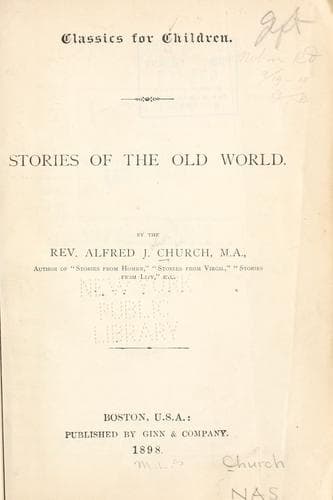
Mythology, Greek -- Juvenile literature; Mythology, Roman -- Juvenile literature
And when the Sphinx found that her riddle was answered, she cast
herself from a high rock and perished. Now for a while Œdipus reigned
in great power and glory; but afterwards his doom came upon him, so
that in his madness he put out his own eyes. Then his two sons cast him
into prison, and took his kingdom, making agreement between themselves
that each should reign for the space of one year. And the elder of the
two, whose name was Eteocles, first had the kingdom; but when his year
was come to an end, he would not abide by his promise, but kept that
which he should have given up, and drave out his younger brother from
the city. Then the younger, whose name was Polynices, fled to Argos, to
King Adrastus. And after a while he married the daughter of the King,
who made a covenant with him that he would bring him back with a high
hand to Thebes, and set him on the throne of his father. Then the King
sent messengers to certain of the princes of Greece, entreating that
they would help in this matter. And of these some would not, but others
hearkened to his words, so that a great army was gathered together,
and followed the King and Polynices to make war against Thebes. So
they came and pitched their camp over against the city. And after that
they had fought against it many days, and yet had prevailed nothing,
Adrastus held a council of the chiefs, and it was agreed that next day,
early in the morning, they should assault the city with all their
might. And when the morning was come the chiefs were gathered together,
being seven in number. And first of all they slew a bull, and caught
the blood of the beast in the hollow of a shield, into which they
dipped their hands, and sware a great oath that they would take the
city of Thebes or die. And having sworn, they hung upon the chariot of
Adrastus what should be memorials of them, each for his own father and
mother, all weeping the while. After this they cast lots for the places
which they should take, for there were seven gates to the city, that
each chief might assault a gate.
But their purpose was known to the King, Eteocles, for he had heard the
whole matter from Tiresias, the wise seer, who told beforehand all that
should come to pass, discovering it from the voice of birds; for, being
blind he could not judge from their flight, or from the tokens of fire,
as other soothsayers are wont. Wherefore the King gathered together
all that could bear arms, even youths not grown, and old men that were
waxed feeble with age, and bade them fight for the land, for “she,” he
said, “gave you birth and reared you, and now asketh that ye help her
in this her need. And though hitherto we have fared well in this war,
know ye for certain, for Tiresias the soothsayer hath said it, that
there cometh a great danger this day upon the city. Wherefore haste ye
to the battlements, and to the towers that are upon the walls, and take
your stand in the gates, and be of good courage, and quit you like men.”
Public-domain text, read in full here on John Shaqi.
Reviews
Reviews
No reviews yet
Be the first to share your thoughts on this work.
Join the Discussion
Join the discussion
Sign in to leave a comment or review.
Sign InorCreate an account