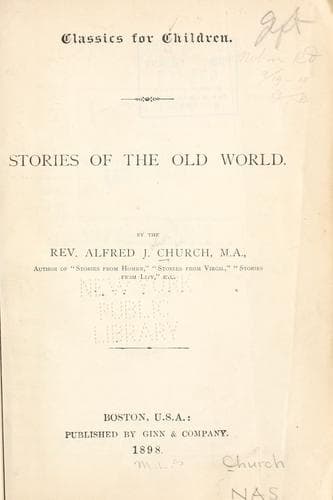
Mythology, Greek -- Juvenile literature; Mythology, Roman -- Juvenile literature
When the two brothers, the sons of King Œdipus, had fallen each by the
hand of the other, the kingdom fell to Creon their uncle. For not only
was he the next of kin to the dead, but also the people held him in
great honor because his son Menœceus had offered himself with a willing
heart that he might deliver his city from captivity. Now when Creon
was come to the throne, he made a proclamation about the two Princes,
commanding that they should bury Eteocles with all honor, seeing that
he died as beseemed a good man and a brave, doing battle for his
country, that it should not be delivered into the hands of the enemy;
but as for Polynices he bade them leave his body to be devoured by the
fowls of the air and the beasts of the field, because he had joined
himself to the enemy, and would have beaten down the walls of the
city, and burned the temples of the Gods with fire, and led the people
captive. Also he commanded that if any man should break this decree he
should suffer death by stoning.
Now Antigone, who was sister to the two Princes, heard that the decree
had gone forth, and chancing to meet her sister Ismené before the gates
of the palace, spake to her, saying, “O my sister, hast thou heard this
decree that the King hath put forth concerning our brethren that are
dead?”
Then Ismené made answer, “I have heard nothing, my sister, only that we
are bereaved of both of our brethren in one day, and that the army of
the Argives is departed in this night that is now past. So much I know,
but no more.”
“Hearken then. King Creon hath made a proclamation that they shall bury
Eteocles with all honor; but that Polynices shall lie unburied, that
the birds of the air and the beasts of the field may devour him, and
that whosoever shall break this decree shall suffer death by stoning.”
“But if it be so, my sister, how can we avail to change it?”
“Think whether or no thou wilt share with me the doing of this deed.”
“What deed? What meanest thou?”
“To pay due honor to this dead corpse.”
“What? Wilt thou bury him when the King hath forbidden it?”
“Yea, for he is my brother and also thine, though perchance thou
wouldst not have it so. And I will not play him false.”
“O my sister, wilt thou do this when Creon hath forbidden it?”
“Why should he stand between me and mine?”
“But think now what sorrows are come upon our house. For our father
perished miserably, having first put out his own eyes; and our mother
hanged herself with her own hands; and our two brothers fell in one
day, each by the other’s spear; and now we two only are left. And shall
we not fall into a worse destruction than any if we transgress these
commands of the King. Think, too, that we are women and not men, and
must of necessity obey them that are stronger. Wherefore, as for me, I
will pray the dead to pardon me, seeing that I am thus constrained; but
I will obey them that rule.”
Public-domain text, read in full here on John Shaqi.
Reviews
Reviews
No reviews yet
Be the first to share your thoughts on this work.
Join the Discussion
Join the discussion
Sign in to leave a comment or review.
Sign InorCreate an account