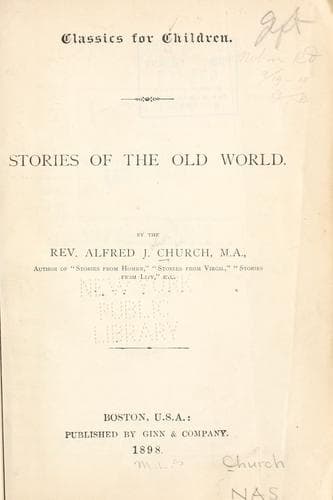
Mythology, Greek -- Juvenile literature; Mythology, Roman -- Juvenile literature
Then the King cried to his people that they should bring bars wherewith
to loosen the doors of the sepulchre, and hasted with them to the
place. But coming on their way to the body of Prince Polynices, they
took it up, and washed it, and buried that which remained of it, and
raised over the ashes a great mound of earth. And this being done, they
drew near to the place of the sepulchre; and as they approached, the
King heard within a very piteous voice, and knew it for the voice of
his son. Then he bade his attendants loose the door with all speed; and
when they had loosed it, they beheld within a very piteous sight. For
the maiden Antigone had hanged herself by the girdle of linen which
she wore, and the young man Prince Hæmon stood with his arms about her
dead corpse, embracing it. And when the King saw him, he cried to him
to come forth; but the Prince glared fiercely upon him, and answered
him not a word, but drew his two-edged sword. Then the King, thinking
that his son was minded in his madness to slay him, leapt back, but
the Prince drave the sword into his own heart, and fell forward on the
earth, still holding the dead maiden in his arms. And when they brought
the tidings of these things to Queen Eurydice, that was the wife of
King Creon and mother to the Prince, she could not endure the grief,
being thus bereaved of her children, but laid hold of a sword, and slew
herself therewith.
So the house of King Creon was left desolate unto him that day, because
he despised the ordinances of the Gods.
THE
STORY OF TROY.
CHAPTER I.
Prince Paris that was son to Priam, King of Troy, carried away the
Fair Helen, wife of Menelaüs, King of Sparta. Now all the kings and
princes of Greece had bound themselves by an oath that they would
avenge Menelaüs on any man that should rob him of his wife. But first
of all they sent ambassadors to Troy, who should demand the Fair Helen
of Priam and his people. So the ambassadors came and made their demand;
and the King himself was willing that she should be given back, and the
wisest of the princes gave like counsel. But there stood up certain
evil men, whom Paris had persuaded with his gold, and said, “Fear not,
men of Troy, to suffer Prince Paris to keep the Fair Helen for his
wife. For verily these words of the ambassadors, that the Greeks will
come with an army and fetch her away, are but idle talk. Think ye that
they will indeed journey so far and endure such trouble for the sake of
a woman? Not so. It standeth not to reason. And if indeed they come,
how shall they take the city? Were not these walls builded of gods, and
shall any man that is born of a woman avail to overthrow them?” And the
men of Troy gave ear to this counsel, and sent away the ambassadors
empty, for the Gods would destroy them.
Public-domain text, read in full here on John Shaqi.
Reviews
Reviews
No reviews yet
Be the first to share your thoughts on this work.
Join the Discussion
Join the discussion
Sign in to leave a comment or review.
Sign InorCreate an account