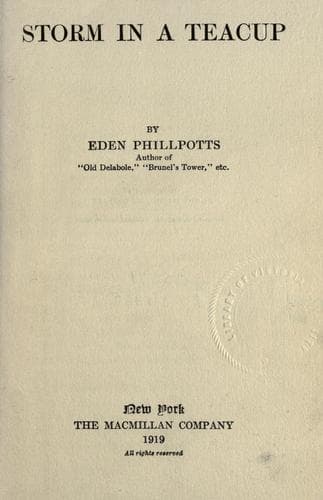
Devon (England) -- Fiction; Husband and wife -- Fiction; Man-woman relationships -- Fiction; Paper mills -- Fiction
“I think more of you—more of you every minute of my life!” sobbed
Medora.
“So there it is, Mrs. Trivett,” summed up the man. “I’m glad you called
and I wish it was in my power to make you see the light in this matter.
But we shall appeal to the future and we’re not in the least afraid of
the verdict of posterity. There’s no support like the consciousness of
right. In fact for my part I’d never take on anything, big or little,
if I didn’t feel to the bed-rock of my conscience it was right. And one
thing you can be quite sure about, and that is that your daughter is as
safe in my hands as it is humanly possible for her to be.”
Mrs. Trivett looked at him helplessly and then at her weeping child.
“You’re one too many for me, Jordan Kellock,” she said. “You’ve thrown
over every law and gone the limit so far as I can see; and yet you talk
about your honour and Medora’s as the only thing you really care about.
You’re beyond me, both of you, and I think I’ll wish you good evening.”
“I feel perfectly sure that light will come into your mind as the
future unfolds itself, Mrs. Trivett.”
“I hope so,” she answered; “but your idea of light and mine ain’t the
same and never will be—unless you change.”
“There’s no shadow of changing with me,” he answered. “Medora’s the
first thing in my life henceforth and, though you don’t agree with
us, I hope you’ll reach a frame of mind when you’ll respect us as we
respect ourselves.”
“You might stop to tea, mother,” suggested Medora, but Mrs. Trivett
declined.
“I don’t want to talk no more,” she said, “so I’ll go; and you needn’t
think I’m an enemy or anything of that. I’m your mother, Medora, and
I’m about the most puzzled mother living this minute.”
Lydia went away deeply mystified and disliking Kellock more than when
she had come. Yet she told herself it was folly to dislike him. He was
no hypocrite, and though his sentiments had seemed ridiculous in any
other mouth, they were really proper to his.
CHAPTER XVII
TRAGEDY IN THE SIZING ROOM
Jordan Kellock accepted the attitude of the Mill to his achievement
with as little emotion as possible. He concealed his own feelings, and
since he did not attach great importance to the opinions of his fellow
workers, their jests or silence were alike indifferent to him. He was
conscious of well-doing and felt no doubt that the future would serve
amply to justify his action.
He worked as usual and presently discovered that neither Ernest Trood,
the foreman, nor Matthew Trenchard himself proposed to discuss his
private affairs with him. The master never mentioned it, and when he
met Kellock, shook hands with his usual large friendliness and trusted
the vatman had enjoyed his holiday.
“You went to the Exhibition I hope?” he asked. And Jordan replied that
he had done so.
“Our pictures made a proper sensation,” he declared. “I stood by and
watched the public for an hour, and the people were more astonished at
our water-mark pictures than anything in the show.”
Public-domain text, read in full here on John Shaqi.
Reviews
Reviews
No reviews yet
Be the first to share your thoughts on this work.
Elsewhere in the archive
Join the Discussion
Join the discussion
Sign in to leave a comment or review.
Sign InorCreate an account