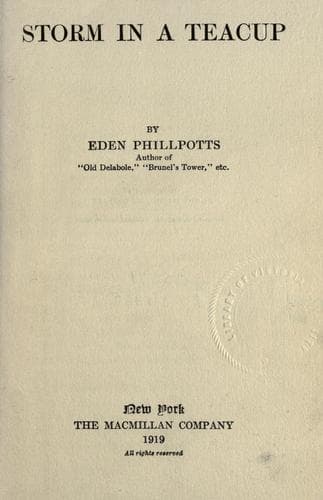
Devon (England) -- Fiction; Husband and wife -- Fiction; Man-woman relationships -- Fiction; Paper mills -- Fiction
“You shall see what the press said,” replied Trenchard. “We’ve had very
good notices about it and far beyond the trade too. Art papers have
taken up water-marks and pointed out what I told you long ago, that the
craft ought to have a great future.”
Of Medora nothing was said, but Trood mentioned her briefly a few days
later. He took Kellock aside.
“It’s official, and no more,” he remarked. “But I suppose you stand for
Mrs. Dingle now, and are going to marry her as soon as it can be done?”
“That is so, Trood.”
“Well, she went away without warning, and forfeits her money
accordingly. You know the law on that subject.”
“That’s all right,” said Kellock. “She didn’t mean nothing uncivil or
improper, but the circumstances required her to act as she did.”
Trood nodded and left him. In common with most of the other responsible
men in the Mill, he never addressed Kellock on the subject of Medora.
Jordan noticed this, and felt that though people abstained from
comment, his action had created a body of opinion that was to some
extent unfriendly. None hesitated to regret the departure of Ned
Dingle, and none attempted to conceal that regret in the presence
of Kellock. A few men refused to recognise him farther, and when he
saluted them as usual, cut him. Robert Life was one of these, and he
found that those who came immediately under the influence of Nicholas
Pinhey—the men at the glazing rollers—had been imbued with particular
animosity. There Medora herself had worked.
As for her, she lived through a familiar experience, and discovered
that anticipation is greater than reality, both for good and evil. She
had built up a very elaborate picture of her return to Dene, and of
the attitude of her circle. It was a vision wherein she occupied the
centre, as a being mysterious and arresting, a figure to challenge
hatred, or enthusiasm, a compelling heroine, who might provoke furious
enemies, or win loyal friends, but could by no possibility leave anyone
indifferent. She had pictured herself as the protagonist, the cynosure,
the paramount object of interest. When she walked abroad in her London
clothes, all eyes would be upon her, and she would move among them,
gentle, indifferent, inscrutable, her secrets hidden, herself doubtless
a subject of ceaseless and heated discussion.
Public-domain text, read in full here on John Shaqi.
Reviews
Reviews
No reviews yet
Be the first to share your thoughts on this work.
Elsewhere in the archive
Join the Discussion
Join the discussion
Sign in to leave a comment or review.
Sign InorCreate an account