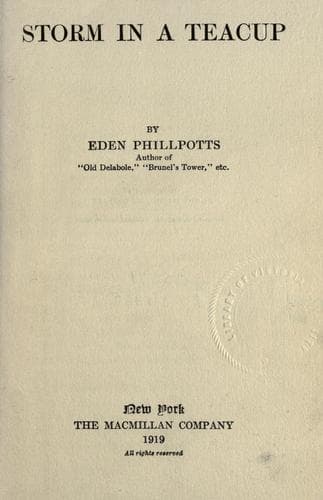
Devon (England) -- Fiction; Husband and wife -- Fiction; Man-woman relationships -- Fiction; Paper mills -- Fiction
Watchfully she would guard her own mind against any doubt of Jordan’s
essential qualities. His virtue and valour culminated, of course, in
the heroism that had run away with her and rescued her from her dragon.
The only weak and unintelligent action impartial judges might have
brought against Kellock must be to Medora his supreme expression of
masterful will and manly humanity. Even granting his love, indifferent
spectators had criticised Kellock most for believing Medora at all,
or allowing the assurances of such a volatile person to influence him
upon such a crucial matter. His real heroism and distinction of mind
was lost upon Medora; the achievements she valued in him belonged to
his weakness of imagination and a lack of humour destined to keep him
a second class man. He belonged to the order of whom it may be said
that they are “great and good,” not that they are “great.” But the good
qualifies—even discounts—the great.
While Jordan had to be supported on his pillar at any cost if Medora’s
position was to be endurable, conversely it was necessary to preserve
her acute sense of Ned Dingle’s evil doing. There must be no slackening
of her detestation there; and that it now became necessary to practise
a large patience with Jordan and take no farther steps to impress upon
him her scorn of one so mean and base as Ned, quite distracted Medora.
Herein Kellock’s composure at first mystified her until he made clear
the need for it.
“To reasonable minds like yours and mine,” he said, “no doubt it does
appear rather improper that we should have to be worldly wise about Mr.
Dingle. But, though the wisdom of the world is foolishness in the mind
of most clean thinking and honourable men, Medora, especially in a case
like this, yet I don’t see that we can do anything. We must just bend
to the law and mark time, I suppose. I don’t go so far as to say we
should demean ourselves to cultivate Mr. Dingle and be humble to him,
or anything like that; but it’s no good going out of the way to vex him
more than we are bound to do; because, the law, being what it is—all
on his side seemingly, we’re more or less powerless and quite in his
hands. It’s abominably wrong it should be; but we’ve got to recognise
the world as it is, and pay it the hypocrisy that virtue owes to vice
sometimes. In fact we’ve got to keep our nerve and lie low and wait for
him. And being what he is—hard and up against us and still smarting
under what happened—he may not be moved to do right all in a minute.”
“He’s making fools of us in fact—that’s his low revenge,” said Medora.
“He may think so in his ignorance, but he’s wrong. Only two people can
make fools of us,” answered Jordan, “and that’s we ourselves. We’ve
took the high line and we’re safe accordingly. All he’ll get out of
delay is the pangs of conscience; and what’s more he’ll put himself
wrong with the rest of the world.”
Public-domain text, read in full here on John Shaqi.
Reviews
Reviews
No reviews yet
Be the first to share your thoughts on this work.
Elsewhere in the archive
Join the Discussion
Join the discussion
Sign in to leave a comment or review.
Sign InorCreate an account