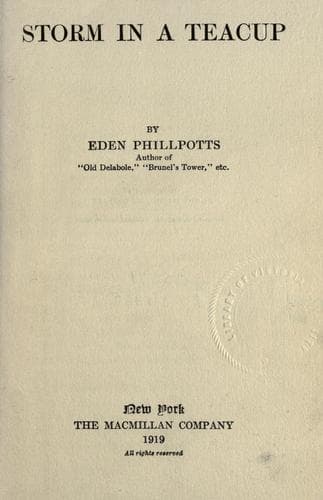
Devon (England) -- Fiction; Husband and wife -- Fiction; Man-woman relationships -- Fiction; Paper mills -- Fiction
“That’s some comfort,” said Medora. “They smart most who smart last, I
reckon. All the same it’s a blackguard thing on his part.”
“The law moves a lot slower than human passion,” he explained, “and
though we say hard speeches against it, there is some advantage in
a machine that can’t be got to gallop as fast as man’s hate. It may
happen that, as time goes on, he’ll come to see that it’s a very
unmanly thing to talk about damages, because when it comes to that,
what price the damage he inflicted on your heart and nature? Many a
woman would have gone down under the persecution, and it was only your
own fine spirit and bed-rock pluck and courage that kept you from doing
so.”
Medora approved these opinions, for praise was her favourite food, and
had Kellock understood the powers of flattery, he had always succeeded
in calming her tempests and exacting patience and obedience. But he
loved her and his love saw her in roseal light as a rule. He forgave
her little turpitudes and bitternesses and ebullitions, for was it not
natural that one who had so cruelly suffered should sometimes betray
those human weaknesses from which none is free?
And for her, if the man had only been a husband to her, nothing on
earth would have shaken her resolution, or weakened her will power. But
that he was not, and her state of widowhood proved exceedingly painful
to one of Medora’s sanguine temperament, though this was the last
thing in her heart she could confess to Kellock. She panted in fact
for a lover sometimes; yet the consciousness that Jordan never panted
for anything of the sort made it impossible to hint at such a human
weakness.
She found the line of least resistance was humble surrender to
Kellock’s high qualities. She abased her spirit at thought of his
sacrifice and really saw aright in the question of his love for her.
About that she could not make any mistake, for she had a mind quick
enough in sundry particulars and sufficiently realised that she had
won a man who would never fail her—a tower of strength—even though
the tower threw rather a heavy shadow. Her own nature was subdued to
what it had to work in; she wandered far from herself under these
excitations. She was, indeed, so little herself that she did not want
to be herself any more. But that ambition could not last. She felt
herself moving sometimes—the love of laughter and pleasure, the need
for stimulus, the cry for something to anticipate with joy. There was
no room for these delights, at any rate at present, in the purview of
Kellock. He continued solemn and staid, patient and wise, sometimes
quite inscrutable. He was magnificent, but not life—as Medora saw
life. Living with Jordan almost suggested living in church; and church
never had been Medora’s life, but rather an occasional interlude,
depending for its charm on the clothes she was wearing at the time. She
became a good deal depressed at this season and wept many secret tears.
Public-domain text, read in full here on John Shaqi.
Reviews
Reviews
No reviews yet
Be the first to share your thoughts on this work.
Elsewhere in the archive
Join the Discussion
Join the discussion
Sign in to leave a comment or review.
Sign InorCreate an account