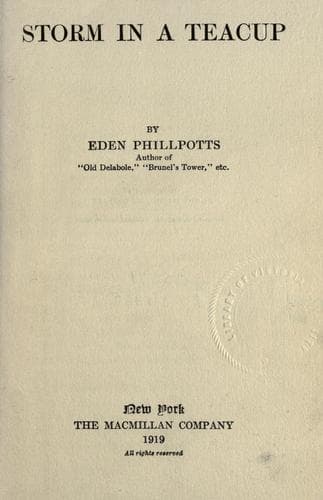
Devon (England) -- Fiction; Husband and wife -- Fiction; Man-woman relationships -- Fiction; Paper mills -- Fiction
“We must get at him—for Lydia’s sake,” declared Mary. “She shan’t be
trapped to her doom by an unknown creature like that if I can prevent
it.”
“There’s surely something beastly to the man,” asserted Tom,
“otherwise, after he’d once seen what my sister was in this house, he’d
have understood it was a vain and selfish plot to try and get her out
of it.”
“She’s always talking about the greatest good to the greatest number,”
added Mary, “and now ’tis for her to practise what she preaches. Here
there’s ten want her; and is one doubtful male, come from Lord knows
where, to count against all her nearest and dearest? God forbid!”
“Well, I hope she’ll see it like that; and if she don’t, we must make
it our business to queer that man’s pitch. If you and me, working
heart and soul for our children and the family in general, can’t get
this foreigner on the run, we’re not what I think we are.”
* * * * *
Next morning Mary was far too indisposed to rise, and before she went
to work, Lydia took her up a cup of tea and three slices of toast and
butter.
“I’ve decided, Mary,” she said, “and if it’s any comfort to you to know
it, I may tell you that I shall stop here.”
Whereupon Mary wept again, held Mrs. Trivett’s hand and kissed it.
“Blessed be your name,” she gurgled, “and may God’s reward meet the
case, Lydia. I’d give you all the kingdoms of earth if they was mine.”
CHAPTER XXI
THE PROTEST
At one end of the glazing house—a lofty and bright workroom at the
top story of the Mill—stood the dry press, to which the choice papers
demanding extra finish came after glazing. Here they were piled between
heavy slabs of hot metal and subject to great pressure; but the primal
business of glazing had already been done between metal rollers. A
range of these presented the principal object in this workshop.
Girls prepared the paper for the rollers, and Medora had once been of
this cheerful and busy throng. Hither came the paper from its final
drying after the size bath, and the workers stood with a heap of sheets
on one side of them and a little stack of polished zinc plates on the
other. With her left hand each girl snatched a sheet of paper, with
her right a plate of zinc; and then she inter-leaved the paper with
the metal until a good wad rose in her crib. The paper was now ready
for the glazing rollers, and men, who tended these massive machines,
ran the sheets and zinc wads between the steel rollers, backward and
forward twice and thrice under tremendous strain. Then what was dim and
lustreless reappeared with a bright and shining surface, and the sheets
returned again to the girls, who separated zinc and paper once more.
Mr. Pinhey had often preached on this text—indeed his simile was worn
threadbare, though he repeated it to every new-comer in the glazing
house and rolling room.
Public-domain text, read in full here on John Shaqi.
Reviews
Reviews
No reviews yet
Be the first to share your thoughts on this work.
Elsewhere in the archive
Join the Discussion
Join the discussion
Sign in to leave a comment or review.
Sign InorCreate an account