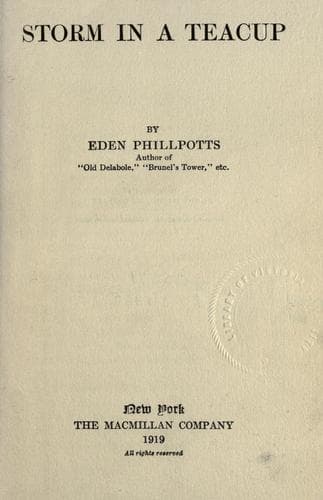
Devon (England) -- Fiction; Husband and wife -- Fiction; Man-woman relationships -- Fiction; Paper mills -- Fiction
“With paper as with humans,” he would say, “nothing like a sharp pinch
to bring out the polish; that is if a man’s built of stuff good enough
to take a polish. Of course some are not; we know that only too well.”
The distinctive sounds in this great shop were three and did he hear
them, a paper maker with his eyes shut would know exactly where he was.
First, the steady thud of the plates on the side of the wooden cribs;
next, the ceaseless rustle and hiss of the paper flying between the
girl’s hands as it is laid upon the zinc or snatched off it; and lastly
the rumble of the rolling machines sounding a bass as they grip the
piles of paper and metal and squeeze them up and down.
The very precious papers went to the dry press; but the mass of them
passed directly to the sorters, who graded all stock into three
qualities—perfect, less perfect, and inferior. No inferior paper
ever left Dene Mill. It was pulped again; but could not aspire to the
highest standard having once sunk beneath it.
And lastly it came to Mr. Pinhey—the finisher—who seemed a figure
conceived and planned for this lofty purpose. Spick and span in his
snowy apron, with delicate hands and quick eyes behind their shining
glasses, he moved spotless through the mountains and masses of the
finished article; he passed amid the ordered blocks magisterially—a
very spirit of purity who reigned over the reams and called them
by their names. Wove and laid Imperial, Super-royal, Medium, Demy,
Foolscap and Double Foolscap were all included. Here towered orange
and old rose sections; here azure and ultramarine; here sea green,
here opaline pink and every delicate shade of buff and cream, to the
snowy whiteness of the great papers and mightiest sheets. From fairy
note to “double elephant” ranged Mr. Pinhey’s activity. He worked among
the papers, great and small, and put the last touch of perfection and
completeness before they passed away into the larger world.
But to-day Nicholas was concerned with a little affair outside the
province of the finisher. On a sheet of palest pink, a sheet that
seemed actually itself to blush at the delicacy of its task, Mr. Pinhey
had written a few sentences in his happiest manner and was handing it
round the shop, that men and women might set their names thereto. He
told everybody that he much disliked such an appeal and protest, but
that his sense of propriety made it necessary, for conscience sake, to
proceed. He was honest in this assurance and did not deceive himself.
Some of his co-workers, who declined to sign, thought that Mr. Pinhey
was conducting his cathartic mission from private motives, not of
the highest, and frankly told him so; but they were wrong. The man
steadfastly believed that religion demanded his action. He had debated
the problem for many weeks and at last come to the conclusion that a
strong step must be taken.
Public-domain text, read in full here on John Shaqi.
Reviews
Reviews
No reviews yet
Be the first to share your thoughts on this work.
Elsewhere in the archive
Join the Discussion
Join the discussion
Sign in to leave a comment or review.
Sign InorCreate an account