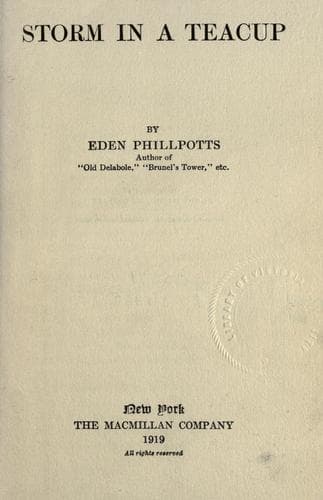
Devon (England) -- Fiction; Husband and wife -- Fiction; Man-woman relationships -- Fiction; Paper mills -- Fiction
A boat moved on Bow Creek, and in it there sat two men and a young
woman. One man rowed while his wife and the other man watched him.
He pulled a long, powerful stroke, and the little vessel slipped up
the estuary on a tide that was at flood, pondering a moment before the
turn. The banks were a blaze of autumn colour, beneath which shelving
planes of stone sank down to the water. The woman twirled an umbrella
to dry it from the recent storm. She was cold and shivered a little,
for though the sun shone again, the north wind blew.
“I’m fearing we oughtn’t to have come, Medora,” said the man who sat
beside her.
“Take my coat,” advised Medora’s husband. “It’s dry enough inside.”
He stopped rowing, took off his coat and handed it to his wife, who
slipped it over her white blouse, but did not thank him.
Medora Dingle was a dark-faced girl, with black hair and a pair of
deep, brown eyes—lovely, but restless—under clean, arched eye-brows.
Her mouth was red and small, her face fresh and rosy. She seemed
self-conscious, and shivered a little more than was natural; for she
was strong and hearty enough in body, tall and lithe, one who laboured
six days a week and had never known sickness. Two of her fingers were
tied up in cotton rags, and one of the wounds was on her ring finger so
that her wedding ring was not visible.
Presently Edward Dingle put down the oars.
“Now you can take it on, old chap,” he said, and then changed places
with his companion. The men were very unlike, but each comely after
his fashion. Dingle was the bigger—a broad-shouldered, loose-limbed
youth of five-and-twenty, with a head rather small for his bulk,
and a pleasant laughter-loving expression. He was fair and pretty
rather than handsome. His features were regular, his eyes blue, his
hair straw-coloured and curly. A small moustache did not conceal his
good-humoured mouth. His voice was high-pitched, and he chattered
a great deal of nothing. He was a type of the slight, kindly man
taken for granted—a man whose worth is under-valued by reason of his
unimportance to himself. He had a boundless good nature combined with a
modest mind.
Jordan Kellock stood an inch or two shorter than Dingle and was a
year or two older. He shaved clean, and brushed his dark, lustreless
hair off his high forehead without parting it. Of a somewhat sallow
complexion, with grey, deliberate eyes and a clean-cut, thin-lipped
mouth, his brow suggested idealism and enthusiasm; there was a light in
his solemn eyes and a touch of the sensitive about his nose. He spoke
slowly, with a level, monotonous accent, and in this also offered an
abrupt contrast to his companion.
It seemed that he felt the reality of life and was pervious to
impressions. He rowed with less mannerism, and a slower stroke than his
friend; but the boat moved faster than it had with Dingle at the oars,
for Kellock was a very strong man, and his daily work had developed his
breast and arms abnormally.
Public-domain text, read in full here on John Shaqi.
Reviews
Reviews
No reviews yet
Be the first to share your thoughts on this work.
Join the Discussion
Join the discussion
Sign in to leave a comment or review.
Sign InorCreate an account