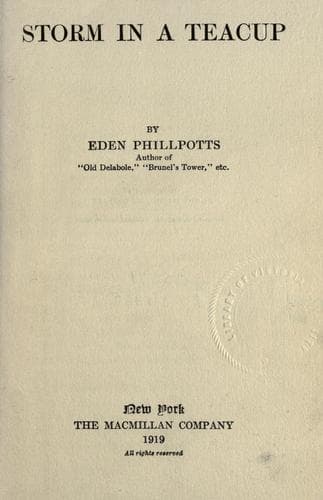
Devon (England) -- Fiction; Husband and wife -- Fiction; Man-woman relationships -- Fiction; Paper mills -- Fiction
The boiler-house lay under an arched roof of corrugated iron. It was
a damp place, full of hot air and the heavy scent of washing. The
steam thinned and feathered away through holes in the roof. In the
floor were deep square hollows and here the boilers revolved, with
a solemnity proper to their size. They were huge metal receptacles
capable of holding a ton each; and when the rag was packed, with water
and alkalies to cleanse it, the loaded giant turned ponderously over
and over, churning the mass for three or four hours. Then the seething
clouts were dragged forth, their pollutions drained away and further
stages of lustration entered upon.
Thus far the rag had come under rough control and reign of law. By air
and water and chastening of many blows it was reduced to a limp and
sodden condition, amenable to discipline, more or less prepared for the
tremendous processes between its final disintegration as rag and its
apotheosis as paper.
A paper man will tell you he turns “old shirts into new sheets”: and
that indeed is what he does; but a long and toilsome journey lies
between the old shirt and its apotheosis.
Henry Barefoot was a placid man, as long as the rag came to him exactly
when he wanted it. Under ordinary circumstances he accomplished his
part in the great machine as obscurely as any invisible wheel, or
steam pipe. But if the women delayed, or he was “hung up,” as he put
it, then his chivalry broke down and he swore long and loud at those
who interfered with his activities. At such times he became tragic and
exceedingly profane. He expanded and broke into uncouth gestures and
simian scowls. He appealed to Heaven in these great moments and asked
of the sky why women had been created. Sometimes his sister, Alice, was
sent for from the thresher to pacify him, and when she failed, Lydia
Trivett, at the sound of Henry’s roaring in the boiler-house, would
slip from her lattice and strive to calm his fury.
The women had fled before him at one of these explosions and Alice
having also failed, approached Mrs. Trivett and begged her to
intervene.
She went, to find Mr. Barefoot standing with steam about him and his
hand lifted to the corrugated iron roof above his grey head.
“Oh, my God, my God!” he said. “What have I done to be the prey of a
lot of worthless females—”
“Your rag’s waiting, Henry,” interrupted Lydia.
“His rag’s out, I should think,” said a woman from behind Lydia. “An
evil-speaking toad—always blasting us. And how can we help it?”
“You know very well, Henry, there must be a hitch sometimes with such a
lot of dirty rag,” explained Lydia. “We’ve all got to keep going, and
it’s no more good or sense cussing us than it is for them in the engine
house to cuss you. And men wouldn’t do this work half as well as women,
as you’d very soon find if we were gone. And it’s a very ill-convenient
thing for you to lose your temper, and nobody will be sorrier than you
in an hour’s time.”
As the rag now awaited him, Henry subsided.
Public-domain text, read in full here on John Shaqi.
Reviews
Reviews
No reviews yet
Be the first to share your thoughts on this work.
Join the Discussion
Join the discussion
Sign in to leave a comment or review.
Sign InorCreate an account