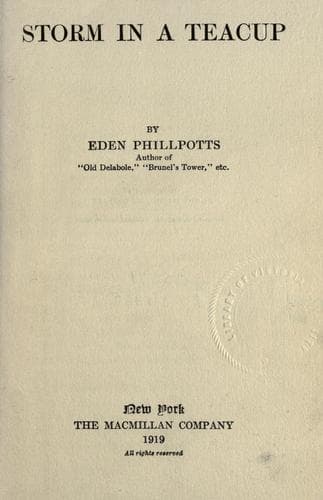
Devon (England) -- Fiction; Husband and wife -- Fiction; Man-woman relationships -- Fiction; Paper mills -- Fiction
Dingle, satisfied with his pupil, put on his coat when the dinner bell
rang, the steam pulses of the works subsided and the power stopped.
He took his basket and descended a long flight of steps to the vat
room, where Kellock, Life and the other paper makers had just knocked
off work. Others joined them, for the vast and airy vat room was a
favourite place for dinner; but Medora did not come. For several weeks
now she had ceased to meet Ned at the hour of the mid-day meal. The
fact was, of course, noted and debated behind Dingle’s back; but none
spoke of it in front of him.
The change in Medora at this stage of her existence was obvious enough
to all; while that which marked her husband did not appear so clearly.
The reason had been easy to see, though few knew enough about them to
see it. Medora, while really disingenuous, revealed her tribulation,
because she desired everybody to perceive it; while Ned, naturally an
open and simple creature, endeavoured with the instinct of a decent
male to hide his worries from the public eye. He failed, however,
because he was not built to play a part, while Medora succeeded to
perfection. Thus she created an impression of secret woes that did not
really exist, while Ned attempted to conceal anxieties which were real
enough. His temper suffered under a strain that he was not created to
endure, for his wife’s attitude, having first puzzled him, began to
anger him. He lost his temper with her on certain occasions and her
sublime patience under his rough tongue by no means turned his wrath
from her. For nothing is more maddening, if you are the smiter, than to
have the other cheek turned to you by a sufferer, who displays obvious
gusto at your chastisement. Ned soon saw that Medora liked him to be
violent and brutal. It was meat and drink to her to see him in a rage.
He guessed, and not wrongly, that if he had beaten her, she must have
relished the pain—not for itself, but for the exquisite pleasure of
relating her sufferings to other people afterwards.
She was changed, as any woman is who for pleasure or profit plays a
part. Indeed many persist in such histrionics when profit has long
ceased, for simple artistic delight at the impersonation. It is natural
to prefer a rôle which we can perform to perfection, before others
wherein we are not so effective.
Public-domain text, read in full here on John Shaqi.
Reviews
Reviews
No reviews yet
Be the first to share your thoughts on this work.
Join the Discussion
Join the discussion
Sign in to leave a comment or review.
Sign InorCreate an account