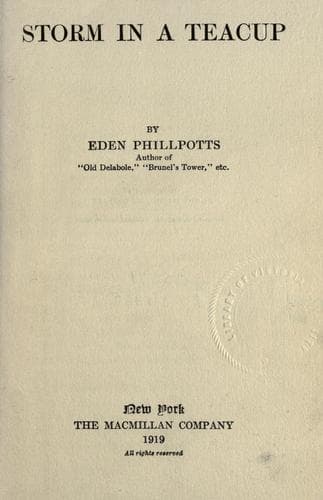
Devon (England) -- Fiction; Husband and wife -- Fiction; Man-woman relationships -- Fiction; Paper mills -- Fiction
Then there was no more play-acting for Medora. Outraged in every
instinct, her sense of humour dead and her self-consciousness morbidly
hypertrophied, she began to hate the man she had married. The cause of
his changed attitude she forgot; and the bad usage for which she had
deliberately played, when it came she resented with all her soul. Now
she ceased to be a wife to him and daily threatened to leave him.
A series of incidents more or less painful led to the threshold of
complete estrangement and Medora was always ahead of her husband and
always a good stage farther advanced to the final rupture than was he.
Indeed he never knew until the climax burst upon him that it was so
near. He did wrong things at this season, was hard when he should have
been gentle, and allowed himself brutalities of speech and action.
But again and again after such ebullitions, he was contrite, abased
himself and implored Medora to help him to a better comradeship and
understanding.
Each sought to confide, and Ned confided in Medora herself, while she
went elsewhere. Her interest was rapidly shifting and her husband’s
efforts at reconciliation meant nothing now. For the time being she
heartily loathed him, and the sound of his voice in the house, and
the fall of his foot. Yet between his furies he had struggled hard to
restore their friendship. He had confessed the incident with Kellock
and described to Medora how, in his passion that anybody should presume
to come between them, even with good advice, he had turned on the
vatman, knocked him into the water and then pulled him out again.
“He meant well; but it shows what a state I’m in that I could do it. He
forgave me quickly enough, but I couldn’t forgive myself. And I only
tell you, Medora, to show what a perilous and unnatural frame of mind
I’ve got to. It’s all so properly cruel—as if some unseen devil had
poked his claws into our affairs and was trying to tear ’em apart. And
God knows I’ll do any mortal thing that man can do to right it.”
She was, however, much more interested in the disaster to Kellock.
“What did he say that made you try to murder him?” she asked.
“I didn’t try to murder him—I only shut his mouth. So I don’t know
what he was going to say. He admitted I was right anyway, and that it
was not his place to interfere.”
“Nobody’s got the right to talk sense to you seemingly.”
“I’m not telling you this for you to begin on me again,” he said. “I’m
telling you to show you what you’re doing and what you’ve done to my
temper. If anybody had told me a year ago I’d forget myself and knock a
man down for trying to do me a good turn, I’d never have believed it.
Yet such is my state that I did so. And since then I’ve asked Jordan to
speak about the thing and give me any advice he could; but he’s told me
frankly the time has passed for that. He won’t speak now. He forgave
me for knocking him into the water; but I can see with half an eye he
don’t want any more to do with me.”
Public-domain text, read in full here on John Shaqi.
Reviews
Reviews
No reviews yet
Be the first to share your thoughts on this work.
Join the Discussion
Join the discussion
Sign in to leave a comment or review.
Sign InorCreate an account