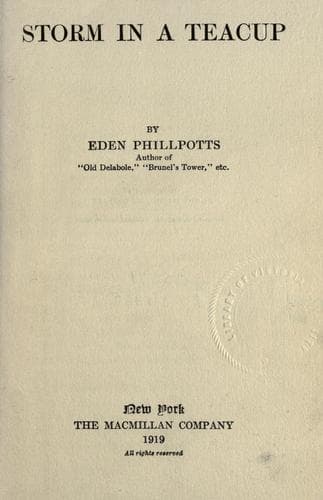
Devon (England) -- Fiction; Husband and wife -- Fiction; Man-woman relationships -- Fiction; Paper mills -- Fiction
“You don’t mean that, Medora?”
“I do then. He’s far ways different from what he was, or what
anybody thinks. He may pretend in the works; but he’s got the temper
of a devil; and sometimes I wish he’d strike and finish me; and
sometimes—I’m young and I don’t like to think of dying—sometimes I
say to myself I’ll make a bolt for it and go out into the world and
chance it. The world would be kinder than him and anyway it couldn’t be
crueller.”
“This is fearful—fearful,” he exclaimed. “I can’t stand you saying
these things, Medora.”
“I wouldn’t if they weren’t true. It can’t go on. I hate to distress
you, but there’s not a soul in the world cares a button what becomes
of me but you. I’m punished for the past I suppose. I deserve it.
I took that cruel tyrant when I might have took you—there, don’t
listen to me. I’m mad to-day.” She worked herself into tears and wept
convulsively, while he stared helplessly out at the world. His mind
moved. He could not stand her continued suffering, and the confession
and assurance of danger inspired him to thoughts of action. Something
must be done. She was in evident peril now. Any day might bring the
awful news of a disaster beyond repair. Such things were in every
newspaper. Not for an instant did he doubt the critical nature of the
situation. He hated to think Medora must presently return home to sleep
under the same roof as her husband. To his order of mind the situation
appealed with the uttermost gravity, for not an inkling of the true
Medora tinctured his impression and he was as ignorant of the true
Ned. He trusted the woman absolutely and he loved her. He steadfastly
believed now that the most precious life in the world to him was in
torment and in danger. She had, under dreadful stress of emotion as it
appeared, more than once expressed her regret at the fatal step in the
past. She had mourned frankly and explicitly at taking Dingle, when she
might have married Kellock himself.
Here then was the tremendous problem for him; and so pressing and
immediate did it appear, that the young man was driven out of his usual
level attitude of mind and customary deliberation before the demands of
life. For the moment his future ambitions and purposes were lost: he
was only urged by the instant necessity to decide what might best be
done for Medora’s sake. Immense prospects opened before him—knightly
deeds, and unconventional achievements calling for great efforts and an
indifference to all commonplace, social standards.
Public-domain text, read in full here on John Shaqi.
Reviews
Reviews
No reviews yet
Be the first to share your thoughts on this work.
Join the Discussion
Join the discussion
Sign in to leave a comment or review.
Sign InorCreate an account