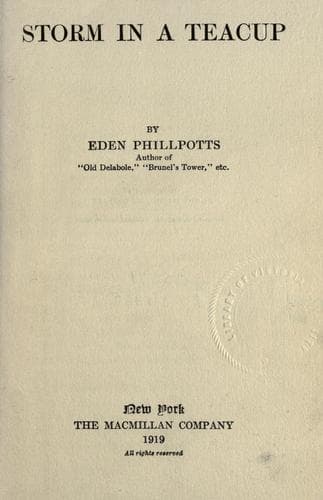
Devon (England) -- Fiction; Husband and wife -- Fiction; Man-woman relationships -- Fiction; Paper mills -- Fiction
The master twisted round on his office chair, then rose and lighted a
cigarette. He was clean-shaved with iron-grey hair and a searching but
genial expression. His face shone with intelligence and humour. It was
strong and accurately declared the man, for indomitable perseverance
and courage belonged to Matthew Trenchard.
His own success he attributed to love of sport and love of fun. These
pursuits made him sympathetic and understanding. He recognised his
responsibilities and his rule of conduct in his relations with the
hundred men and women he employed was to keep in closest possible
touch with them. He held it good for them and vital for himself that
he should know what was passing in their minds; for only thus could he
discover the beginning of grievances and destroy them in the egg. He
believed that the longer a trouble grew, the more difficult it was to
dissipate, and by establishing intimate relations with his staff and
impressing upon them his own situation, his successes and his failures,
he succeeded in fixing unusual bonds.
For the most part his people felt that Trenchard’s good was their
own—not because he said so, but because he made it so; and save for
certain inevitable spirits, who objected on principle to all existing
conditions between capital and labour, the workers trusted him and
spoke well of him.
Kellock was first vatman at Dene, and one of the best paper makers in
England. Both knew their worth and each was satisfied with the other.
“I’ve heard from that South American Republic, Kellock,” said Mr.
Trenchard. “They like the new currency paper and the colour suits them.”
“It’s a very fine paper, Mr. Trenchard.”
“Just the exact opposite of what I’m after for these advertisements.
The public, Kellock, must be appealed to by the methods of Cheap Jack
at the fair. They love a conjuring trick, and if you can stop them
long enough to ask ‘how’s it done?’ you often interest them and win
them. Now samples of our great papers mean nothing to anybody but the
dealers. The public doesn’t know hand-made paper from machine-made.
What we’ve got to do is to show them—not tip-top paper, but a bit of
magic; and such a fool is the public that when he sees these pictures
in water-mark, he’ll think the paper that produces them must be out of
the common good. We know that it’s not ‘paper’ at all in our sense,
and that it’s a special brew for this special purpose; but the public,
amazed by the pictures, buys our paper and doesn’t know that the better
the paper, the more impossible such sleight of hand would be upon it.
We show them one thing which awakes their highest admiration and causes
them to buy another!”
All this Jordan Kellock very well understood, and his master knew that
he did; but Trenchard liked to talk and excelled in lucid exposition.
Public-domain text, read in full here on John Shaqi.
Reviews
Reviews
No reviews yet
Be the first to share your thoughts on this work.
Join the Discussion
Join the discussion
Sign in to leave a comment or review.
Sign InorCreate an account