African Americans -- New York (State) -- New York; Riots -- New York (State) -- New York
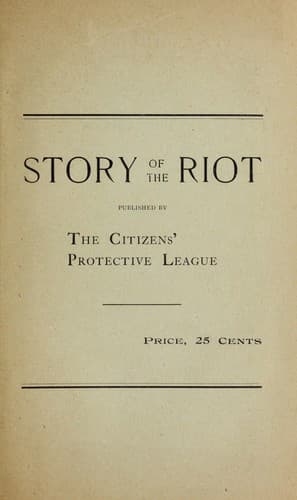
The colored people of the city, realizing their unexpected danger
as a race, and discovering the surprising unwillingness of the city
authorities to punish their assailants and to protect them in the
future, formed "The Citizens' Protective League." This society and
the Society for the Prevention of Crime and the City Vigilance League
communicated with the Mayor in writing and urged him to hold an
investigation or to direct the Commissioner of Accounts to hold one for
him. His answer was that the whole matter was in the hands of the Board
of Police. A number of Negroes who had been injured retained Israel
Ludlow, Esq., to bring suits against the city for damages inflicted on
them by the mob. He filed with the Police Commissioners the affidavit
of William J. Elliott, who had been clubbed in the station house. The
Police Board began its "investigation" by calling Elliott and his
witnesses on the 7th of September. The examination of witnesses was
conducted by the President of the Board, Bernard J. York, and, with the
approval of the Board, he refused to give subpoenas to Mr. Ludlow, and
refused to allow him or any other lawyer to examine or cross-examine
any witnesses, or to suggest any step to be taken. Elliott and all
other colored witnesses were examined by the President as hostile
parties, and their testimony was controverted by the policemen who
were called at once and were carefully nursed and led by him. Glaring
discrepancies and disagreements in their testimony were passed over in
spite of specific protests by Mr. Ludlow. The writer appeared on behalf
of the societies that had memorialized the Mayor, and filed a complaint
of inefficiency and neglect of duty against the Captain, the Inspector,
and the Chief of Police, and announced that he had much testimony to
offer on the specifications, but insisted on his right to examine
his own witnesses and to cross-examine the police witnesses. These
rights were emphatically denied, and the complaint was disdainfully
pigeonholed.
The Protective League separately asked the Mayor for justice; he
responded that the whole matter was with the Police Board, and he
made the same response to Mr. Ludlow, who complained to him of the
farce that was being enacted at Police Headquarters. The hearing was
continued several days. Witnesses were examined superficially in eight
cases of cruelty by policemen, and were controverted by double the
number of policemen, and it was suddenly announced that the hearings
were closed. Claims of sixteen Negroes against the city were then on
file in the Comptroller's office, the names and addresses of many
more victims had appeared in the newspapers, and the writer had
announced that he had in his possession over forty affidavits of police
brutality. The "investigation" was a palpable sham.
Public-domain text, read in full here on John Shaqi.
Reviews
Reviews
No reviews yet
Be the first to share your thoughts on this work.
Join the Discussion
Join the discussion
Sign in to leave a comment or review.
Sign InorCreate an account