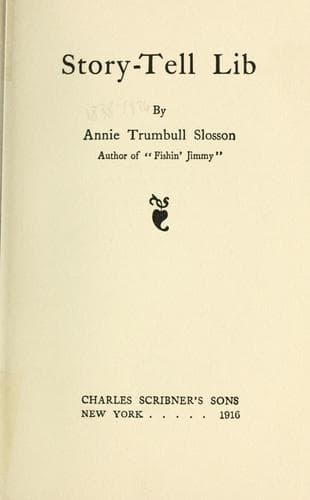
Conduct of life -- Fiction; People with disabilities -- Fiction; Short stories; Storytellers -- Fiction
Well, the shet-up posy was dreadful worked up. "Deary dear!" she says to
herself, "now if they'd on'y finished me off inside! I'm the right kind
outside, humly and queer enough, but there's nothin' worth lookin' at
inside,--I'm certin sure o' that." But she didn't say this nor anything
else out loud, and bimeby, when the man had waited, and didn't get any
answer, he begun to look at the shet-up posy more partic'lar, to see why
she was so mum. And all of a suddent he says, the man did, "Looks to
me's if you was somethin' that kind yourself, ain't ye?" "Oh, no, no,
no!" whispers the shet-up posy. "I wish I was, I wish I was. I'm all
right outside, humly and awk'ard, queer's I can be, but I ain't pretty
inside,--oh! I most know I ain't." "I ain't so sure o' that myself,"
says the man, "but I can tell in a jiffy." "Will you have to pick me to
pieces?" says the shet-up posy. "No, ma'am," says the man; "I've got a
way o' tellin', the one I work for showed me." The shet-up posy never
knowed what he done to her. I don't know myself, but 'twas somethin'
soft and pleasant, that didn't hurt a mite, and then the man he says,
"Well, well, well!" That's all he said, but he took her up real gentle,
and begun to carry her away. "Where be ye takin' me?" says the shet-up
posy. "Where ye belong," says the man; "to the gardin o' the one I work
for," he says. "I didn't know I was nice enough inside," says the
shet-up posy, very soft and still. "They most gen'ally don't," says the
man.
The Horse that B'leeved he'd Get there
III
Among those who sometimes came to listen to little Lib's allegories was
Mary Ann Sherman, a tall, dark, gloomy woman of whom I had heard much.
She was the daughter of old Deacon Sherman, a native of the village, who
had, some years before I came to Greenhills, died by his own hand, after
suffering many years from a sort of religious melancholia. Whether the
trouble was hereditary and his daughter was born with a tendency
inherited from her father, or whether she was influenced by what she
had heard of his life, and death, I do not know. But she was a dreary
creature with never a smile or a hopeful look upon her dark face.
Nothing to her was right or good; this world was a desert, her friends
had all left her, strangers looked coldly upon her. As for the future,
there was nothing to look forward to in this world or the next. As Dave
Moony, the village cynic, said, "Mary Ann wa'n't proud or set up about
nothin' but bein' the darter of a man that had c'mitted the onpar'nable
sin." Poor woman! her eyes were blinded to all the beauty and brightness
of this world, to the hope and love and joy of the next. What wonder
that one day, as she paused in passing the little group gathered around
Lib, and the child began the little story I give below, I thought it
well fitted to the gloomy woman's case!
The Horse that B'leeved he'd Get there
Public-domain text, read in full here on John Shaqi.
Reviews
Reviews
No reviews yet
Be the first to share your thoughts on this work.
Join the Discussion
Join the discussion
Sign in to leave a comment or review.
Sign InorCreate an account