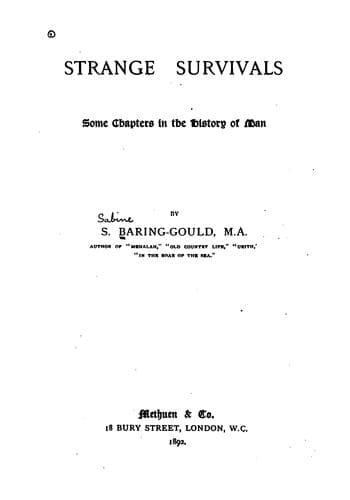
Strange Survivals: Some Chapters in the History of ManBaring-Gould, S. (Sabine)
History
Strange Survivals: Some Chapters in the History of Man
Baring-Gould, S. (Sabine)
Manners and customs -- Origin; Superstition
In 1653, Dorothy Osborne tells Sir William Temple that she has received
from her brother a ballad “much older than my ‘Lord of Lorne,’ and she
sends it on to him.” Would that she had told us more about it. And then
she writes, “The heat of the day is spent in reading or working, and
about six or seven o’clock I walk out into a common that lies hard by
the house, where a great many young wenches keep sheep and cows, and
sit in the shade singing of ballads. I go to them and compare their
voices and beauties to some ancient shepherdesses that I have read of,
and find a vast difference there; but, trust me, I think these are as
innocent as those could be. I talk to them, and find they want nothing
to make them the happiest people in the world but the knowledge that
they are so.”
Walton in his “Complete Angler,” printed in the very same year in which
Dorothy Osborne wrote to her lover of the singing peasant girls, says:
“I entered into the next field, and a second pleasure entertained me:
’twas a handsome milk-maid, that had cast away all care, and sung like
a nightingale; her voice was good, and the ditty fitted for it; ’twas
that smooth song which was made by Kit Marlow, now at least fifty years
ago; and the milk-maid’s mother sung an answer to it, which was made by
Sir Walter Raleigh in his younger dayes.”
We know what the song was, “Come, live with me and be my love.”
The mother says to Walton, “If you will but speak the word, I will
make you a good sillabub, and then you may sit down in a hay-cock and
eat it, and Maudlin shall sit by and sing you the good old song of the
Hunting in Chevy Chase, or some other good ballad, for she hath good
store of them: Maudlin hath a notable memory.”
But ballad-singing was not confined to milk-maids and clowns, for
Walton proposes to spend a pleasant evening with his brother, Peter,
and his friends, “to tell tales, or sing ballads, or make a catch, or
find some harmless sport to content us.”
It is a somewhat sad fact--fact it is, that the ballad is at its last
gasp among us. It has gone through several phases, and it has now
reached the last, when it disappears altogether.
The ballad was anciently a story set to music, and music to which
the feet could move in dance. The _ballet_ is the dance to which the
_ballad_ was sung. It was not always danced to, but it always could be
danced to. It was of great length, but not too long for light hearts
or light feet on a threshing-floor. The ballad was accommodated to the
exigencies of the dance, by being given a burden, or _bourdon_, a drone
that was sung by the young men, when no bagpipe was there. This burden
appears in numerous ballads, and has usually no reference to the story
told by the singers, and when printed is set in italics. In the scene
in the “Winter’s Tale,” already quoted, the servant alludes to these
burdens, “He has the prettiest love-songs for maids--with such delicate
burdens of ‘dildos and fadings.’”
Thus:--
Public-domain text, read in full here on John Shaqi.
Reviews
Reviews
No reviews yet
Be the first to share your thoughts on this work.
Elsewhere in the archive
Join the Discussion
Join the discussion
Sign in to leave a comment or review.
Sign InorCreate an account