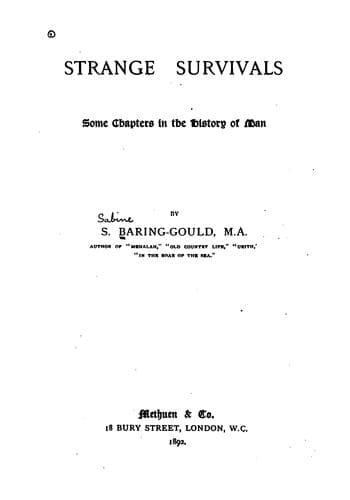
Strange Survivals: Some Chapters in the History of ManBaring-Gould, S. (Sabine)
History
Strange Survivals: Some Chapters in the History of Man
Baring-Gould, S. (Sabine)
Manners and customs -- Origin; Superstition
“There was a lady in the North country,
_Lay the bent to the bonny broom_,
And she had lovely daughters three,
_Fa, la la la; fa, la la la ra re_.”
or:--
“There were three sisters fair and bright,
_Jennifer, Gentle, and Rosemaree_,
And they three loved one valiant knight,
_As the doo (dove) flies over the mulberry tree_.”
In the first edition of Playford’s “Dancing Master,” in 1650-1,
nearly every air can be proved to have been that of a song or ballad
of earlier date than the book. Of these only a few have the words
preserved, and we cannot be sure that the words of those we have got
were the original, as ballads were continually being written afresh.
It was not till about 1690 that tunes were composed expressly for
dancing, and in the later editions of the “Dancing Master,” 1715 and
1728, about half the airs given are old ballad tunes. The other half,
newly composed dance tunes, had no traditional words set to them, and
none were composed to fit them.
In the old English romance of “Tom of Reading,” printed before 1600, we
have an instance of the way in which a ballad came to be turned into
a dance. Tom Dove was an Exeter clothier passionately fond of music.
William of Worcester loved wine, Sutton of Salisbury loved merry tales,
Simon of Southampton “got him into the kitchen and to the pottage and
then to a venison pasty.”
Now a ballad was composed relative to Tom of Exeter:--
“Welcome to town, Tom Dove, Tom Dove,
The merriest man alive.
Thy company still we love, we love,
God grant thee well to thrive.
And never will we depart from thee
For better or worse, my joy!
For thou shalt still have our good-will,
God’s blessing on my sweet boy.”
And the author adds, “This song went up and down through the whole
country, and at length became a dance among the common sort.”
The old heroic ballad was a _geste_, and the singer was a gestour.
Chaucer speaks of--
“Jestours that tellen tales
Both of seeping and of game.”
The tales of game were stories calculated to provoke laughter, in which
very often little respect was paid to decency; sometimes, however,
they were satirical. These tales of game were much more popular than
those of weeping, and the gestour, whose powers were mainly employed
in scenes of conviviality, finding by experience that the long lays
of ancient paladins were less attractive than short and idle tales
productive of mirth, accommodated himself to the prevailing coarse
taste, and the consequence was that nine of the pieces conceived in a
light vein have been preserved to every one of the other.
In the “Rime of Sir Thopas,” Chaucer speaks of--
“Minestrales
And gestours for to tellen tales,
Of romaunces that ben reales,
Of popes and of cardinales
And eke of love-longing.”
Public-domain text, read in full here on John Shaqi.
Reviews
Reviews
No reviews yet
Be the first to share your thoughts on this work.
Elsewhere in the archive
Join the Discussion
Join the discussion
Sign in to leave a comment or review.
Sign InorCreate an account