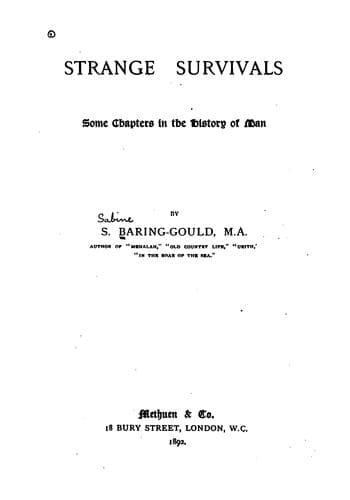
Strange Survivals: Some Chapters in the History of ManBaring-Gould, S. (Sabine)
History
Strange Survivals: Some Chapters in the History of Man
Baring-Gould, S. (Sabine)
Manners and customs -- Origin; Superstition
“In summer-time, when leaves grow green,
And blossoms bedecke the tree,
King Edward wold a hunting ryde,
Some pastime for to see.”
or:--
“There came a bird out o’ a bush,
On water for to dine;
An’ sicking sair, says the King’s dochter,
O wae’s this heart o’ mine,” etc.
or:--
“There was a pretty shepherd boy
That lived upon a hill,
He laid aside his bag o’ pipes
And then he slept his fill.”
or:--
“O! blow away, ye mountain breezes,
Blow the winds, heigh-ho!
And clear away the morning kisses,
Blow the winds, heigh-ho!” etc.
The ring of the latter is fresh and pleasant; the former have no
ring at all. The first articles are manufactured in a garret by a
publisher’s poetaster, the latter have sprung spontaneously from the
hearts of the people in the merry month of May.
Of black-letter printed ballads, the earliest we have are, “The
Nut-brown Maid,” which was discovered in a book of customs, dues, etc.,
published at Antwerp, about 1502, and “The Ballade of the Scottish
King,” written by John Skelton, poet laureate to King Henry VIII., and
of the date 1513. This was found within the binding of an old book that
was knocking about on the floor of a garret in a farmhouse at Whaddon,
in Dorset. Mr. Arber’s Transcripts of the entries in Stationers’ Hall
give us the list of ballads issued from the press, with their dates.
The list begins in the year 1557. We will take a few extracts only.
1588, 4th March. John Wolfe obtained leave to print three ballads; one
was, “Goe from my window, goe.” Now this no longer exists as a ballad,
but as a folk-tale, in which occur snatches of rhyme, with a certain
melody attached to them; and this air, with the snatches of rhyme,
has been preserved. Both are printed by Mr. Chappell in his “Popular
Music of the Olden Time.” What the subject of the ballad was the writer
learned from a blacksmith, who told him that he was in a village inn
about 1860, when a very old man came in, and standing by the fire,
recited and sang the following story:--
“Two men courted a pretty maid; the one was rich, the other was poor;
and the rich man was old, but the poor man she loved; he was young. Her
father forced her to marry the rich man, but still she loved the poor
man; and sometimes he came under her window and tapped, and when the
husband was away she let him in.
“So passed a twelvemonth and a day, and she had a little child.
“Then one night the lover came under the window, thinking her goodman
was from home. With his tapping the husband woke, and asked what the
sound was. She said an ivy leaf was caught in a cobweb, and fluttered
against the pane. Then the lover began to call, and her husband asked
what that sound was. She said the owls were hooting in the night. But
fearing lest her lover should continue to call and tap, she began to
sing, as she rocked the cradle:--
Public-domain text, read in full here on John Shaqi.
Reviews
Reviews
No reviews yet
Be the first to share your thoughts on this work.
Elsewhere in the archive
Join the Discussion
Join the discussion
Sign in to leave a comment or review.
Sign InorCreate an account