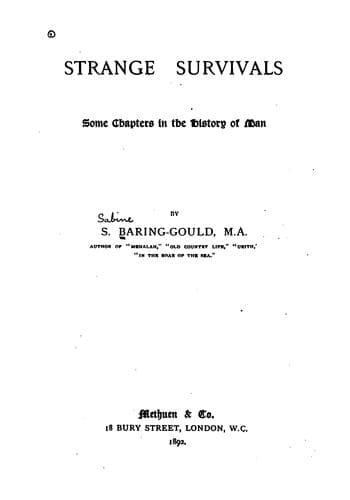
Strange Survivals: Some Chapters in the History of ManBaring-Gould, S. (Sabine)
History
Strange Survivals: Some Chapters in the History of Man
Baring-Gould, S. (Sabine)
Manners and customs -- Origin; Superstition
“‘Begone, begone, my Willy, my Billy!
Begone, my love and my dear.
O the wind, and O the rain,
They have sent him back again,
So thou can’st not have a lodging here.’
“Again the lover tapped, and the husband asked what that meant. She
said it was a flittermouse that had flown against the pane. Then she
sang:--
“‘Begone, begone, my Willy, my Billy!
Begone, my love and my dear.
O the weather is so warm,
It will never do thee harm,
And thou can’st not have a lodging here.’
“Then the lover began to call a third time, and the husband asked what
it was. She said it was the whistling of the wind among the trees, and
she sang:--
“‘Begone, begone, my Willy, my Billy!
Begone, my love and my dear.
O the wind is in the West,
And the cuckoo’s in his nest,
So thou can’st not have a lodging here.’
“Again the lover tapped. Then she sprang out of bed, threw open the
casement, and sang:--
“‘Begone, begone, my Willy, you silly;
Begone, you fool, yet my dear.
O the devil’s in the man,
And he can not understan’
That he cannot have a lodging here.’”
The melody was arranged for Queen Elizabeth, and is in her Virginal
Book. In Beaumont and Fletcher’s “Knight of the Burning Pestle,” old
Merrythought says,
“Go from my window, love, go;
Go from my window, my dear.
The wind and the rain
Will drive you back again;
You cannot be lodged here.
“Begone, begone, my juggy, my puggy;
Begone, my love, my dear.
The weather is warm;
’Twill do thee no harm;
Thou can’st not be lodged here.”
It is again quoted in Fletcher’s “Monsieur Thomas,” and again in “The
Tamer Tamed.”
Almost certainly this was originally a ballad. But the ballad tale has
been lost, and only scraps of rhyme were committed to writing.
1588, 26th Sept. John Wolfe had license to print “Peggy’s Complaint for
the Death of her Willye.”[37]
9th Nov. Thomas Orwyn had license to print “Martyn said to his man, Who
is the foole now?”
This has been preserved for us, with its tune, by Ravenscroft, in his
“Deuteromelia.”
“Martyn said to his man, fie man, fie O!
Who’s the fool now?
Martyn said to his man, fill the cup and I the can,
Thou hast well drunken, man,
Who’s the fool now?
“I see a sheep sheering come, fie man, fie O!
And a cuckold blow his horn.
“I see a man in the moon
Clouting St. Peter’s shoon.
“I see a hare chase a hound
Twenty miles above the ground.
“I see a goose ring a hog,
And a snayle that did bite a dog.
“I see a mouse catch a cat,
And the cheese to eat a rat.”
1591, 27th August. Robert Bourne obtained license to print a ballad on
“A combat between a man and his wife for the breeches.” This has been
often re-written.
1592, 5th Jan. Richard Jones, “The Valliant Acts of Guy of Warwick,” to
the tune of “Was ever man soe tost (lost) in love?” The ballad of Guy
is lost. The tune we have.
Public-domain text, read in full here on John Shaqi.
Reviews
Reviews
No reviews yet
Be the first to share your thoughts on this work.
Elsewhere in the archive
Join the Discussion
Join the discussion
Sign in to leave a comment or review.
Sign InorCreate an account