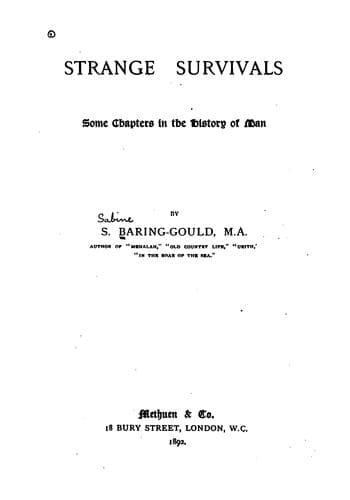
Strange Survivals: Some Chapters in the History of ManBaring-Gould, S. (Sabine)
History
Strange Survivals: Some Chapters in the History of Man
Baring-Gould, S. (Sabine)
Manners and customs -- Origin; Superstition
1592, 18th Jan. H. Kyrkham, “The crowe she sitteth upon a wall:”
“Please one and please all.” The former is, perhaps, the original of
“The crow sat in a pear-tree.” “Please one and please all” has been
preserved.
1592, 21st July. John Danter, “The soules good morrowe.”
1592, 28th July. H Kyrkham, “The Nightingale’s Good-night.”
1593, 1st Oct. Stephen Peel, “Betwixt life and death,” to the tune of
“Have with you into the country.”
1594, 16th Oct. John Danter, “Jones’ ale is new.” This is sung to the
present day in village taverns. One verse is roared forth with special
emphasis. It is that of the mason:--
“He dashed his hammer against the wall;
He hoped both tower and church would fall;
For Joan’s ale is new, my boys,
For Joan’s ale is new.”
1594, 16th Oct. E. White, “The Devil of Devonshire and William of the
West, his Sonne.” This is lost.
1595, 14th Jan. Thomas Creede, “The Saylor’s Joye,” to the tune of
“Heigh-ho! hollidaie.” Both ballad and air lost.
1595, 24th Feb. Thomas Creede, The first part of “The Merchante’s
Daughter of Bristole.” This we have, but it is a recast in the
sixteenth century of a far earlier ballad.
1595, 15th Oct. Thomas Millington, “The Norfolk Gentleman, his Will and
Testament, and howe he committed the keeping of his children to his
owne brother.” This--“The Babes in the Wood,” we have, as well as the
melody.
1595, 15th Oct. W. Blackwall, “The Prowde Mayde of Plymouthe.” Lost.
1603, 11th June. Wm. White, “A Sweet Maie Flower;” “The Ladie’s Fall;”
“The Bryde’s Buriell;” “The Spanish Ladie’s Love;” “The Lover’s
Promises to his Beloved;” “The Fayre Lady Constance of Cleveland and of
her Disloyal Knight.”
We have “The Lady’s Fall” and the two that follow. “A Sweet Mayflower”
is probably a real loss, as also the ballad of the Lady Constance and
her disloyal knight. This will suffice to show how interesting are
these records, and also how much has perished, as well as how much
is preserved. It must not, however, be lost to mind that these were
all new ballads, and were serving to displace the earlier and better
ballads.[38]
Every accident, every murder, every battle was turned into doggerel and
printed as a new ballad. Fourpence was the cost of a license.
In Beaumont and Fletcher’s “Philastes,” Megra threatens the King--
“By all those gods you swore by, and as many
More of mine own--
The princess, your daughter, shall stand by me
On walls, and sung in ballads.”
She refers to the manner in which every bit of court scandal was
converted into rhythmic jingle, and also to the custom of pasting the
ballads on the walls. The least acquaintance with the old black-letter
ballads will make the reader understand the allusion to the two figures
heading the broadside, in rude woodcut, standing side by side.
Public-domain text, read in full here on John Shaqi.
Reviews
Reviews
No reviews yet
Be the first to share your thoughts on this work.
Elsewhere in the archive
Join the Discussion
Join the discussion
Sign in to leave a comment or review.
Sign InorCreate an account