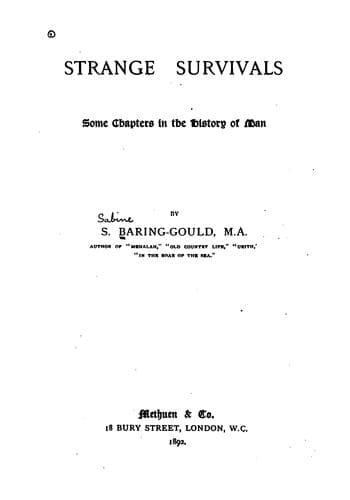
Strange Survivals: Some Chapters in the History of ManBaring-Gould, S. (Sabine)
History
Strange Survivals: Some Chapters in the History of Man
Baring-Gould, S. (Sabine)
Manners and customs -- Origin; Superstition
In one of the early Norse sagas we have a story about a king called
Vikarr, who desired to dedicate himself to the god, and so he had a
gallows erected before his palace, and got a friend to fasten a halter
round his neck and hang him on the gallows. Another tells of a woman
who, to gain her husband’s love, hung her son to the god to obtain his
assistance so as to brew a good vat of ale. At Lethra, in Denmark,
every nine years ninety-nine men, and as many horses, were hung in
honour of the god; and at Upsala numerous human victims swung by the
neck about the image of Odin. After their great victory over the Romans
the Cymbri and Teutons hung all their captives as a thank-offering to
their gods; and after the slaughter of the legions of Varus the horses
of the Romans were found hung on the trees on the scene of defeat.
Indeed, one of the names of Odin was the Hanging God, either because he
hung himself, or because he had victims hung to him.
The world-tree, the great tree in which he hung, the tree which
supports heaven and earth, was called Yggdrasil, which means Ogre’s
horse, for one of the names of Odin was Yggr or Ogre, to express his
love of human sacrifices; and all the old nursery tales and rhymes
concerning ogres have reference to this great god of the English
people. Jack mounts the beanstalk, and above the clouds enters the land
of the Ogre, with his one eye, who devours men. Jack the Giant Killer,
who lives in Cornwall, represents the British Christian fighting
against the Pagan Saxon, impersonated as the great man-eating ogre.
“Fee-fo-fum, I smell the blood of an Englishman.
Whether he be alive, or whether he be dead,
I’ll grind his bones to make my bread.”
In this again we have a reference to Woden or Odin, who was also called
the Miller; for the mutter or roll of the thunder was supposed to be
the working of his quern, grinding up his human victims for his meal.
Originally, victims were either freewill offerings, or were chosen from
among the best in the land. So we hear of a Norse king every ten years
sacrificing one of his sons, and of the Swedes, in time of famine,
sacrificing their king, but it became general to offer the prisoners
taken in war, and when these lacked, to sacrifice those who lay in
prison condemned for crimes.
In one of the Norse sagas, we are told of a king’s daughter that, on
hearing of the death of her father in battle, she went to the valley
dedicated to the gods and there hung herself. Her father, having died
in battle, went to Walhalla to Odin, and her only chance of being with
him in the spirit world was to hang herself to the honour of Odin, who
would then receive her among his elect, and so associate her with her
father. If she were to die in her bed, she would go down to the nether
world of Hela.
Public-domain text, read in full here on John Shaqi.
Reviews
Reviews
No reviews yet
Be the first to share your thoughts on this work.
Elsewhere in the archive
Join the Discussion
Join the discussion
Sign in to leave a comment or review.
Sign InorCreate an account