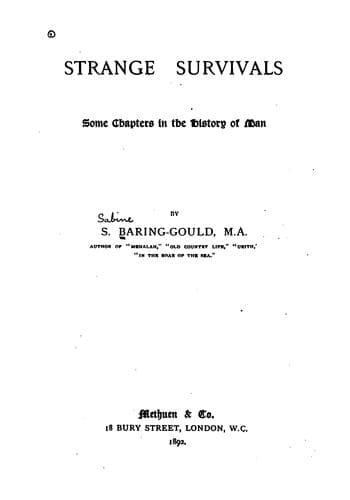
Strange Survivals: Some Chapters in the History of ManBaring-Gould, S. (Sabine)
History
Strange Survivals: Some Chapters in the History of Man
Baring-Gould, S. (Sabine)
Manners and customs -- Origin; Superstition
It is curious that in the West of England there are fields, generally
situated in lonely spots, that go by the name of gallows’-traps, and
the popular saying concerning them is that whoever sets foot in them
is predestined to die on the gibbet. The probable origin of this
superstition is that these were actual traps for the unwary, in which
to catch victims for sacrifice.
In certain districts a parcel of land was set apart to the god, and it
was agreed that whosoever set foot on it should be sacrificed. Usually
this was a stranger, unaware of the sacredness of the ground he
trod. He was seized and hung to Woden. We cannot say for certain that
this is the origin of the gallows-traps, but it is the most probable
explanation of their origin, and of the superstitious dread of them
still existing among the people.
In France and Germany the wheel was used as the instrument of death
as frequently as the gallows; those executed on the wheel were set
upon poles, the wheel horizontal, and their broken limbs intertwined
among the spokes. Originally they were thus put to death as oblations
to the sun-god, whose symbol was the wheel. Little by little the idea
of sacrifice in these executions disappeared. When Germans, Franks,
and Anglo-Saxons became Christian, human sacrifices ceased as a matter
of course, but as it was still necessary to put malefactors to death,
the same kind of death was adjudged to them as before Christianity was
professed. The gradual process whereby human sacrifices were changed
in the classic world is well known to us. At first every victim was a
freewill offering, and even a beast was obliged to appear so. To make
the ox seem to consent to its despatch, drops of oil or water were put
into its ears, that it might nod and shake its head. Prisoners taken in
war, then criminals, were substituted for persons voluntarily devoting
themselves to death to the honour of the gods. When it came to the
execution of criminals, the idea of sacrifice readily evaporated.
One remarkable fact remains to be noticed. In all religions the
sacrifice becomes identified with the god to whom it is offered, and
partakes of his powers.
Whether this be a mere confusion of ideas, or whether there is some
logical process at the bottom, we will not stop to consider, but it
remains a fact everywhere. The victim is always thought to become
invested with some of the attributes of the god.
Public-domain text, read in full here on John Shaqi.
Reviews
Reviews
No reviews yet
Be the first to share your thoughts on this work.
Elsewhere in the archive
Join the Discussion
Join the discussion
Sign in to leave a comment or review.
Sign InorCreate an account