Strange Survivals: Some Chapters in the History of Man — John Shaqi
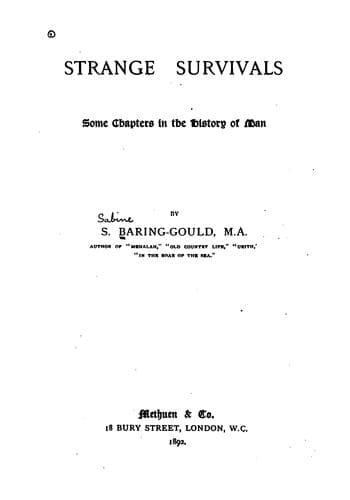
Strange Survivals: Some Chapters in the History of ManBaring-Gould, S. (Sabine)
History
Strange Survivals: Some Chapters in the History of Man
Baring-Gould, S. (Sabine)
Manners and customs -- Origin; Superstition
Every so-called Devil’s Bridge has some story associated with it
pointing to sacrifice, and sometimes to the substitution of an animal
for the human victim. The almost invariable story is that the devil
had been invoked and promised his aid, if given the first life that
passed over the bridge. On the completion of the structure a goat, or
a dog, or a rabbit is driven over, and is torn to pieces by the devil.
At Pont-la-Ville, near Courbières, is a four-arched Devil’s Bridge,
where six mice, then six rats, and lastly six cats, were driven across,
according to the popular story, in place of the eighteen human souls
demanded by the Evil One.
At Cahors, in Ouercy, is a singularly fine bridge over the Lot, with
three towers on it. The lower side of the middle tower could never
be finished, it always gave way at one angle. The story goes that
the devil was defrauded of his due--the soul of the architect--when
he helped to build the bridge, and so declared that the bridge never
should be finished. Of late years the tower has been completed, and
in token that modern skill has triumphed, the Evil One has been
represented on the angle, carved in stone. The legend shows that the
vulgar thought that the bridge should have been laid in blood, and as
it was not so, concluded that the faulty tower was due to the neglect
of the Pagan usage.
The black dog that haunts Peel Castle, and the bloodhound of Launceston
Castle, are the spectres of the animals buried under their walls, and
so the White Ladies and luminous children, who are rumoured to appear
in certain old mansions, are the faded recollections of the unfortunate
sacrifices offered when these houses were first reared, not, perhaps,
the present buildings, but the original manor-halls before the Conquest.
At Coatham, in Yorkshire, is a house where a little child is seen
occasionally--it vanishes when pursued. In some German castles the
apparition of a child is called the “Still child;” it is deadly pale,
white-clothed, with a wreath on the head. At Falkenstein, near Erfurth,
the appearance is that of a little maiden of ten, white as a sheet,
with long double plaits of hair. A white baby haunts Lünisberg, near
Aerzen. I have heard of a house in the West of England, where on a
pane of glass, every cold morning, is found the scribbling of little
fingers. However often the glass be cleaned, the marks of the ghostly
fingers return. The Cauld Lad of Hilton Castle in the valley of Wear
is well known. He is said to wail at night:
“Wae’s me, wae’s me,
The acorn’s not yet
Fallen from the tree
That’s to grow the wood,
That’s to make the cradle,
That’s to rock the bairn,
That’s to grow to a man,
That’s to lay me.”
At Guilsland, in Cumberland, is another Cauld Lad; he is deadly white,
and appears ever shivering with cold, and his teeth chattering.
Public-domain text, read in full here on John Shaqi.
Reviews
Reviews
No reviews yet
Be the first to share your thoughts on this work.
Join the Discussion
Join the discussion
Sign in to leave a comment or review.
Sign InorCreate an account