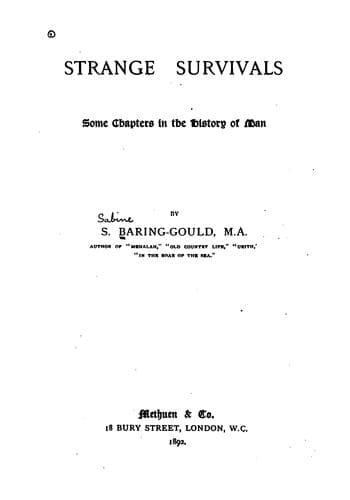
Strange Survivals: Some Chapters in the History of ManBaring-Gould, S. (Sabine)
History
Strange Survivals: Some Chapters in the History of Man
Baring-Gould, S. (Sabine)
Manners and customs -- Origin; Superstition
In mediæval Germany, the giving of a hat was a symbolic act, conveying
with it feudal tenure. He who received the hat put his hand into it,
as a sign that he grasped all those rights which sprang out of the
authority conveyed to him by the presentation of the hat. The Pope,
when creating a Cardinal, sends him a scarlet hat. The wearing the hat
was allowed only to nobles and freemen--no serf might assume one. Among
the Goths, the priests as well as the nobles wore the head covered.
When Gessler set a hat on a pole, it was a token that he was exercising
sovereign authority. The elevation of a hat on a pole was also a
summons of vassals to war, like the raising of a royal standard. In a
French Court of Justice, the judges alone wear their heads covered,
in token that they are in exercise of authority there. So in our own
universities, the tutor or lecturer wears his square cap. So in the
cathedral, a bishop was wont to have his head covered with the mitre;
and in a parish church, the pastor wore a biretta. We take off our hats
when entering church to testify our homage and allegiance to God; and
so in old Catholic ritual, the priest and bishop removed their headgear
at times, in token that they received their offices from God.
It roused the Romans to anger because the fillet of royalty was offered
to Julius Cæsar. This was the merest shred of symbol--yet it meant that
he alone had a right to wear a cover on his head; in other words, that
all save he were vassals and serfs. That presentation by Mark Antony
brought discontent to a head, and provoked the assassination of Cæsar.
Odin, the chief god of Norse mythology, is called Hekluberand, the
Hood-bearer; he alone has his head covered. As god of the skies
this no doubt refers to the cloud-covering, but it implies also his
sovereignty. So Heckla is not only the covered mountain, but the king
or chief of the mountains of Iceland.
We can now see exactly what is the meaning of doffing the cap. It
implies that the person uncovering his head acknowledges himself to be
the serf of the person before whom he uncovers, or at all events as his
feudal inferior. How completely this is forgotten may be judged in any
walk abroad we take--when we uncover to an ordinary acquaintance--or we
can see it in the Landgrave of Hesse-Homburg removing his hat to the
postillion. The curtsey, now almost abandoned, is the bowing of the
knee in worship; so is the ordinary bend of the body; even the nod of
the head is a symbolic recognition of inferiority in the social scale
to the person saluted.
The head is the noblest part of man, and when he lifts his hat that
covers it, he implies, or rather did imply at one time, that his head
was at the disposal of the person to whom he showed this homage.
Public-domain text, read in full here on John Shaqi.
Reviews
Reviews
No reviews yet
Be the first to share your thoughts on this work.
Elsewhere in the archive
Join the Discussion
Join the discussion
Sign in to leave a comment or review.
Sign InorCreate an account