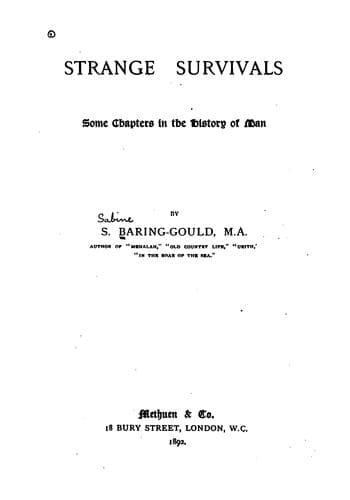
Strange Survivals: Some Chapters in the History of ManBaring-Gould, S. (Sabine)
History
Strange Survivals: Some Chapters in the History of Man
Baring-Gould, S. (Sabine)
Manners and customs -- Origin; Superstition
There is a curious story in an Icelandic saga of the eleventh century
in illustration of this. A certain Thorstein the Fair had killed
Thorgils, son of an old bonder in Iceland, named also Thorstein, but
surnamed “The White,” who was blind. The rule in Iceland was--a life
for a life, unless the nearest relative of the fallen man chose to
accept blood-money. Five years after the death of Thorgils, Thorstein
the Fair came to Iceland and went at once to the house of his namesake,
White Thorstein, and offered to pay blood-money for the death of
Thorgils, as much as the old man thought just. “No,” answered the blind
bonder, “I will not bear my son in my purse.” Thereupon, Fair Thorstein
went to the old man and laid his head on his knees, in token that he
offered him his life. White Thorstein said, “I will not have your head
cut off at the neck. Moreover, it seems to me that the ears are best
where they grow. But this I adjudge--that you come here, into my house,
with all your possessions, and live with me in the place of my son whom
you slew.” And this Fair Thorstein did.
At a period when no deeds were executed in parchment, symbolic acts
were gone through, which had the efficacy of a legal deed in the
present day.
When Harald Haarfager undertook to subdue the petty kings of Norway,
one of these kings, Hrollaug, seeing that he had not the power to
withstand Harald, “went to the top of the mound on which the kings were
wont to sit, and he had his throne set up thereon and seated himself
upon it. Then he had a number of feather beds laid on a bench below,
on which the earls were wont to be seated, and he threw himself down
from the throne, and rolled on to the earls’ bench, thus giving himself
out to have taken on him the title and position of an earl.”[53] And
King Harald accepted this act as a formal renunciation of his royal
title. Every head covering was a badge of nobility, from the Crown to
the Cap of Maintenance, through all degrees of coronet. In 1215, Hugh,
Bishop of Liège, attended the synod in the Lateran, and first he took
his place on the bench wearing a mantle and tunic of scarlet, and a
green cap to show he was a count, then he assumed a cap with lappets
(?) _manicata_, to show he was a duke, and lastly put on his mitre and
other insignia as a bishop. When Pope Julius II. conferred on Henry
VIII. the title of “Defender of the Faith,” he sent him as symbols of
authority a sword and a cap of crimson velvet turned up with ermine.
It is probable that originally to uncover the head signified that he
who bared his head acknowledged the power and authority of him whom he
saluted to deal with his head as he chose. Then it came to signify, in
the second place, recognition of feudal superiority. Lastly, it became
a simple act of courtesy shown to anyone.
Public-domain text, read in full here on John Shaqi.
Reviews
Reviews
No reviews yet
Be the first to share your thoughts on this work.
Elsewhere in the archive
Join the Discussion
Join the discussion
Sign in to leave a comment or review.
Sign InorCreate an account