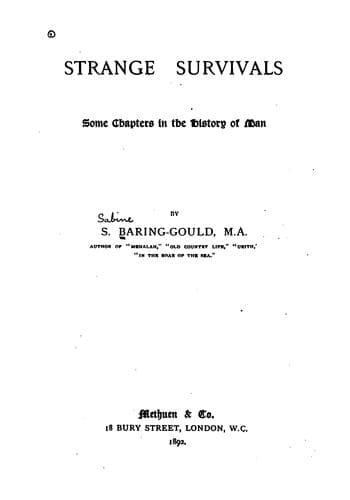
Strange Survivals: Some Chapters in the History of ManBaring-Gould, S. (Sabine)
History
Strange Survivals: Some Chapters in the History of Man
Baring-Gould, S. (Sabine)
Manners and customs -- Origin; Superstition
PROBLEMS OF POVERTY: An Inquiry into the Industrial Conditions of the
Poor. By J. A. HOBSON, M.A.
THE COMMERCE OF NATIONS. By C. F. BASTABLE, M.A., Professor of
Economics at Trinity College, Dublin.
THE ALIEN INVASION. By W. H. WILKINS, B.A., Secretary to the Society
for Preventing the Immigration of Destitute Aliens.
THE RURAL EXODUS. By P. ANDERSON GRAHAM.
LAND NATIONALIZATION. By HAROLD COX, B.A.
A SHORTER WORKING DAY. By H. DE B. GIBBINS (Editor), and R. A.
HADFIELD, of the Hecla Works, Sheffield.
_The following Volumes are in preparation_:--
ENGLISH SOCIALISM OF TO-DAY. By HUBERT BLAND, one of the Authors of
‘Fabian Essays.’
POVERTY AND PAUPERISM. By Rev. L. R. PHELPS, M.A., Fellow of Oriel
College, Oxford.
ENGLISH LAND AND ENGLISH MEN. By Rev. C. W. STUBBS, M.A., Author of
‘The Labourers and the Land.’
CHRISTIAN SOCIALISM IN ENGLAND. By Rev. J. CARTER, M.A., of Pusey
House, Oxford.
THE EDUCATION OF THE PEOPLE. By J. R. DIGGLE, M.A., Chairman of the
London School Board.
WOMEN’S WORK. By LADY DILKE, MISS BEILLEY, and MISS ABRAHAM.
RAILWAY PROBLEMS PRESENT AND FUTURE. By R. W. BARNETT, M.A., Editor of
the ‘Railway Times.’
Printed by T. and A. CONSTABLE, Printers to Her Majesty, at the
Edinburgh University Press.
NOTES
[1] Sacrifices of the same kind were continued. Livy, xxii. 57:
“Interim ex fatalibus libris sacrificia aliquot extraordinaria facta:
inter quæ Gallus et Galla, Græcus et Græca, in Foro Boario sub terra
vivi demissi sunt in locum saxo conseptum, jam ante hostiis humanis,
minime Romano sacro, imbutum.”
[2] Jovienus Pontanus, in the fifth Book of his History of his own
Times. He died 1503.
[3] These cauldrons walled into the sides of the churches are probably
the old sacrificial cauldrons of the Teutons and Norse. When heathenism
was abandoned, the instrument of the old Pagan rites was planted in the
church wall in token of the abolition of heathenism.
[4] There is a rare copper-plate, representing the story, published in
Cologne in 1604, from a painting that used to be in the church, but
which was destroyed in 1783. After her resurrection, Richmod, who was a
real person, is said to have borne her husband three sons.
[5] Magdeburg, Danzig, Glückstadt, Dünkirchen, Hamburg, Nürnberg,
Dresden, etc. (see Petersen: “Die Pferdekópfe auf den Bauerhäusern,”
Kiel, 1860).
[6] Herodotus, iv. 103: “Enemies whom the Scythians have subdued they
treat as follows: each having cut off a head, carries it home with him,
then hoisting it on a long pole, he raises it above the roof of his
house--and they say that these act as guardians to the household.”
[7] The floreated points of metal or stone at the apex of a gable are a
reminiscence of the bunch of grain offered to Odin’s horse.
Public-domain text, read in full here on John Shaqi.
Reviews
Reviews
No reviews yet
Be the first to share your thoughts on this work.
Elsewhere in the archive
Join the Discussion
Join the discussion
Sign in to leave a comment or review.
Sign InorCreate an account