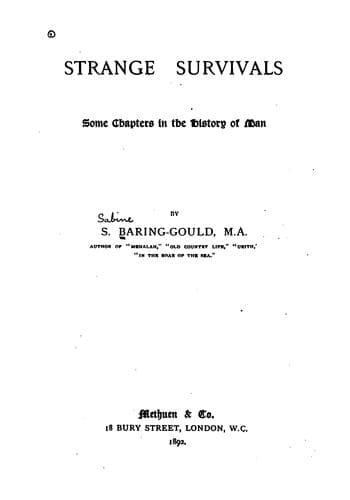
Strange Survivals: Some Chapters in the History of ManBaring-Gould, S. (Sabine)
History
Strange Survivals: Some Chapters in the History of Man
Baring-Gould, S. (Sabine)
Manners and customs -- Origin; Superstition
[8] Aigla, c. 60. An Icelandic law forbade a vessel coming within sight
of the island without first removing its figure-head, lest it should
frighten away the guardian spirits of the land. Thattr Thorsteins
Uxafots, i.
[9] Finnboga saga, c. 34.
[10] Hood is Wood or Woden. The Wood-dove in Devon is Hood-dove, and
Wood Hill in Yorkshire is Hood Hill.
[11] See numerous examples in “The Western Antiquary,” November, 1881.
[12] On a discovery of horse-heads in Elsdon Church, by E. C.
Robertson, Alnwick, 1882.
[13] “Sir Tristram,” by Thomas of Erceldoune, ed. Sir Walter Scott,
1806, p. 153.
[14] See an interesting paper and map, by Dr. Prowse, in the
Transactions of the Devon Association, 1891.
[15] Two types, the earliest, convex on both faces. The later, flat on
one side, convex on the other. The earlier type (Chelles) is the same
as our Drift implements. Till the two types have been found, the one
superposed on the other, we cannot be assured of their sequence.
[16] In the artistic faculty. The sketches on bone of the reindeer race
were not approached in beauty by any other early race.
[17] “The Past and the Present,” by A. Mitchell, M.D., 1880.
[18] The author found and planned some hut circles very similar to
those found in Cornwall and Down, on a height above Laruns. There was a
dolmen at Buzy at the opening of the valley.
[19] Hor. Sat. ii. 8.
[20] Fornaldar Sögur. iii. p. 387.
[21] Heimskringla, i., c. 12.
[22] I have given an account of the Carro already in my book, “In
Troubadour Land.”
[23] Roman and Greek ladies employed parasols to shade their faces from
the sun, and to keep off showers. See s. v. _Umbraculum_ in Smith’s
Dictionary of Greek and Roman Antiquities.
[24] A good deal of information relative to umbrellas may be got out of
Sangster (W.). “Umbrellas and their History.” London: Cassell & Co.,
Ltd.
[25] The first English_man_ who carried an umbrella was Jonas Hanway,
who died in 1786, but it was known in England earlier. Beaumont and
Fletcher allude to it in “Rule a Wife and Have a Wife”:
“Now are you glad, now is your mind at ease;
Now you have got a shadow, an umbrella,
To keep the scorching world’s opinion
From your fair credit.”
And Ben Jonson, in “The Devil is an Ass”:
“And there she lay, flat spread as an umbrella.”
Kersey in his Dictionary, 1708, describes an umbrella as a “screen
commonly used by women to keep off rain.”
[26] Castrén, Nordische Reisen, St. Petersburg, 1853, p. 290.
[27] “The Beggynhof,” London, 1869, p. 68.
[28] Ed. Viger, IV., p. 161.
[29] So Grimm and others following him; but I am more inclined to see
in Herodias, Herr-raud the Red Lord, _i.e._, Thor.
[30] “A Dyalogue describing the orygynall ground of these Lutheran
facyons,” 1531. A later work on the excesses of sectaries is Featley’s
(D.) Dippers Dipt, 1660.
[31] Quoted in _Westminster Review_, Jan., 1860, p. 194.
[32] “Autobiography of Peter Cartwright.” London, 1862 (7th ed.)
Public-domain text, read in full here on John Shaqi.
Reviews
Reviews
No reviews yet
Be the first to share your thoughts on this work.
Elsewhere in the archive
Join the Discussion
Join the discussion
Sign in to leave a comment or review.
Sign InorCreate an account