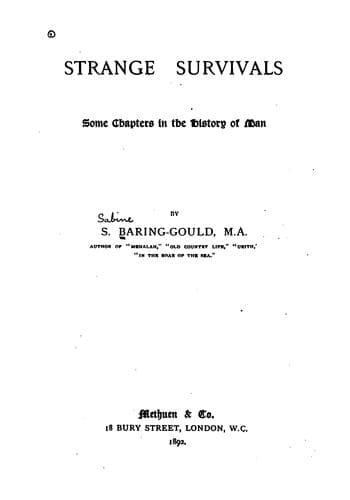
Strange Survivals: Some Chapters in the History of ManBaring-Gould, S. (Sabine)
History
Strange Survivals: Some Chapters in the History of Man
Baring-Gould, S. (Sabine)
Manners and customs -- Origin; Superstition
[33] “The Epidemics of the Middle Ages.” London, 1859.
[34] The word is, of course, derived from _Instrumentum_.
[35] See “Fretella,” in Ducange, “Fistulæ species.”
[36] M. Gilbert prints, “As the dew flies,” etc.; this is a
mistake--“doo” is _dove_.
[37] Possibly we may have this in the still popular Cornish lament,
“Have you seen my Billy coming?”
[38] On December 14, 1624, as many as 128 ballads were licensed, the
names of which are given. “The Blind Beggar (of Bethnal Green);”
“Maudline of Bristowe (The Merchant’s Daughter of Bristol);” “Sweet
Nansie I doe love thee;” “The Lady’s Fall;” “My minde to me a kingdom
is” (Sir Edward Dyer’s famous song); “Margaret, my sweetest;” “In
London dwelt a merchantman;” “I am sorry, I am sorry;” “In May when
flowers springe;” “I am a poore woman and blinde;” “The Devil and the
Paritor (Apparitor);” “It was a Lady’s daughter;” “Roger’s Will;”
“Bateman (Lord);” “Bride’s Good Morrow;” “The King and the Shepherd;”
“As I went forth one summer’s day;” “Amintas on a summer’s day;” “Ah
me, not to thee alone;” “Sir John Barley Corne;” “It was a youthful
knight;” “Jane Shore;” “Before my face;” “George Barnwell;” “From
Sluggish Sleepe;” “Down by a forrest;” “The Miller and the King;”
“Chevie Chase;” “How shall we good husbands live;” “Jerusalem, my
happie home;” “The King and the Tanner;” “Single life the only way;”
“The Lord of Lorne;” “In the daies of old;” “I spide a Nymph trip
over the plaine;” “Shakeing hay;” “Troy Toun;” “Walking of late
abroad;” “Kisse and bide me welcome home;” “The chirping larke;” “John
Carelesse;” “Tell me, Susan, certenly;” “Spanish Lady;” “When Arthur
first in Court;” “Diana and her darlings;” “Dear love, regard my life;”
“Bride’s buryal;” “Shakeing of the sheets;” “A rich merchantman;”
“Gilian of Bramfield;” “Fortune my Foe;” “Cripple of Cornwall;”
“Whipping the catt at Abingdon;” “On yonder hill there springs;” “Upon
a summertime;” “The Miser of Norfolk.”
[39] Friedrich (J.B.) Geschichte des Räthsels, Dresden, 1860.
[40] “Le Dieu Gaulois du Soleil,” Paris, 1886.
[41] “Scriptores rer. German. Frankof.,” 1718, p. 508.
[42] “Eckhard, Monument. Jutreboc,” p. 59.
[43] “Anton, Versaml. uber Sitten d. alten Slawen,” II. p. 97.
[44] The date on this stone is only 1807, so that the practice must be
very modern.
[45] Other dolmens with holes at Trye-le-Château, Presles, les
Mauduits, in Seine et Oise; at Vic-sur-Aisne; at Bellehaye, and at
Villicor--Saint Sépulcre (Oise); and others are in the Morbihan,
Charente, etc.
[46] What we in England term cromlechs, the French more correctly call
dolmens.
[47] The building up of part of the circle round a cairn was probably
to block the way of the spirit in the direction of the village occupied
by the living.
[48] Bull. de la Soc. d’anthropologie de Paris, t. ix., p. 198.
[49] Reinsberg Düringsfeld. “Trad. et Legendes de la Belgique,” 1870,
T. II., p. 239.
[50] Journal of the British Archæological Association, vol. xxxviii.,
1882.
Public-domain text, read in full here on John Shaqi.
Reviews
Reviews
No reviews yet
Be the first to share your thoughts on this work.
Elsewhere in the archive
Join the Discussion
Join the discussion
Sign in to leave a comment or review.
Sign InorCreate an account