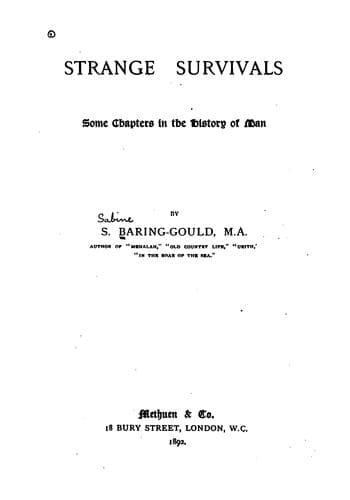
Strange Survivals: Some Chapters in the History of Man — John Shaqi
Strange Survivals: Some Chapters in the History of ManBaring-Gould, S. (Sabine)
History
Strange Survivals: Some Chapters in the History of Man
Baring-Gould, S. (Sabine)
Manners and customs -- Origin; Superstition
In the German household tale of “Godfather Death,” a daring man enters
a cave, where he finds a number of candles burning; each represents
a man, and when the light expires, that man whom it represents dies.
“Jack o’ lanterns” are the spirits of men who have removed landmarks.
One of Hebel’s charming Allemanic poems has reference to this
superstition.
The extinguished torch represents the departed life, and in Yorkshire
it was at one time customary to bury a candle in a coffin, the modern
explanation being that the deceased needed it to light him on his road
to Paradise; but in reality it represented an extinguished life, and
probably was a substitute for the human sacrifice which in Pagan times
accompanied a burial. In almost all the old vaults opened in Woodbury
Church, Devon, candles have been found affixed to the walls. The lamps
set in graves in Italy and Greece were due to the same idea. The candle
took the place of a life, as a dog or sow in other places was killed
instead of a child.
It is curious and significant that great works of art and architecture
should be associated with tragedies. The Roslyn pillar, the Amiens rose
window, the Strassburg clock, many spires, and churches. The architect
of Cologne sold himself to the devil to obtain the plan. A master and
an apprentice carve pillars or construct windows, and because the
apprentice’s work is best, his master murders him. The mechanician of a
clock is blinded, some say killed, to prevent him from making another
like it. Perdix, for inventing the compass, was cast down a tower by
Daedalus.
It will be remembered that the architect of Cologne Cathedral,
according to the legend, sold himself to the devil for the plan, and
forfeited his life when the building was in progress. This really means
that the man voluntarily gave himself up to death, probably to be
laid under the tower or at the foundation of the choir, to ensure the
stability of the enormous superstructure, which he supposed could not
be held up in any other way.
An inspector of dams on the Elbe, in 1813, in his “Praxis,” relates
that, as he was engaged on a peculiarly difficult dyke, an old peasant
advised him to get a child, and sink it under the foundations.
As an instance of even later date to which the belief in the necessity
of a sacrifice lingered, I may mention that, in 1843, a new bridge was
about to be built at Halle, in Germany. The people insisted to the
architect and masons that their attempt to make the piers secure was
useless, unless they first immured a living child in the basement. We
may be very confident that if only fifty years ago people could be
found so ignorant and so superstitious as to desire to commit such an
atrocious crime, they would not have been restrained in the Middle
Ages from carrying their purpose into execution.
Public-domain text, read in full here on John Shaqi.
Reviews
Reviews
No reviews yet
Be the first to share your thoughts on this work.
Join the Discussion
Join the discussion
Sign in to leave a comment or review.
Sign InorCreate an account