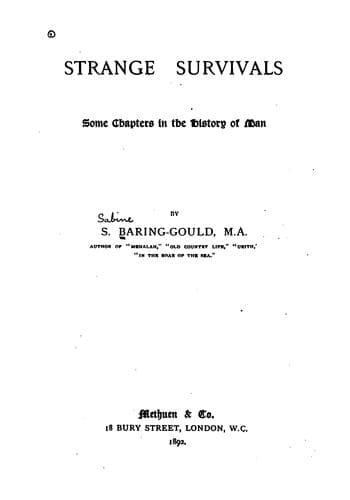
Strange Survivals: Some Chapters in the History of ManBaring-Gould, S. (Sabine)
History
Strange Survivals: Some Chapters in the History of Man
Baring-Gould, S. (Sabine)
Manners and customs -- Origin; Superstition
The eating of this sort of meat was a sacramental token of allegiance
to Odin. When Hakon, Athelstan’s foster-son, who had been baptised in
England, refused to partake of the sacrificial banquet of horse-flesh
at the annual Council in Norway, the Bonders threatened to kill him. A
compromise was arrived at, so odd that it deserves giving in the words
of the saga: “The Bonders pressed the King strongly to eat horse-flesh;
and as he would not do so, they wanted him to drink the soup; as he
declined, they insisted that he should taste the gravy; and on his
refusal, were about to lay hands on him. Earl Sigurd made peace by
inducing the King to hold his mouth over the handle of the kettle
upon which the fat steam of the boiled horse-flesh had settled; and
the King laid a linen cloth over the handle, and then gaped above it,
and so returned to his throne; but neither party was satisfied with
this.” This was at the harvest gathering. At Yule, discontent became
so threatening, that King Hakon was forced to appease the ferment by
eating some bits of horse’s liver.
Giraldus Cambrensis says of the Irish that in Ulster a king is thus
created: “A white mare is led into the midst of the people, is killed,
cut to pieces and boiled; then a bath is prepared of the broth. Into
this the King gets, and sitting in it, he eats of the flesh, the people
also standing round partake of it. He is also required to drink of the
broth in which he has bathed, lapping it with his mouth.” (“Topography
of Ireland,” c. xxv.) This is, perhaps, the origin of the Irish
expression, “a broth of a boy.”
Tacitus tells us that after a defeat of the Chatti, their conquerors
sacrificed horses, ate their flesh, and hung up their heads in trees,
or affixed them to poles, as offerings to Wuotan. So, after the
defeat of Varus and his legions, when Cæcina visited the scene of the
disaster, he found the heads of the horses affixed to the branches and
trunks of the trees. Gregory the Great, in a letter to Queen Brunehild,
exhorted her not to suffer the Franks thus to expose the heads of
animals offered in sacrifice. At the beginning of the fifth century,
St. Germanus, who was addicted to the chase before he was made Bishop
of Auxerre, was wont to hang up the heads and antlers of the game
killed in hunting in a huge pear-tree in the midst of Auxerre, as an
oblation to Odin, regardless of the reproof of his bishop, Amator, who,
to put an end to this continuance of a heathenish ceremony, cut down
the tree.
Public-domain text, read in full here on John Shaqi.
Reviews
Reviews
No reviews yet
Be the first to share your thoughts on this work.
Join the Discussion
Join the discussion
Sign in to leave a comment or review.
Sign InorCreate an account