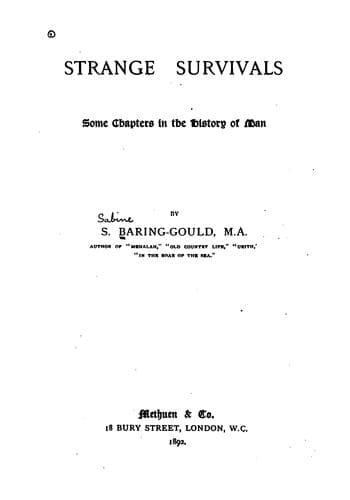
Strange Survivals: Some Chapters in the History of Man — John Shaqi
Strange Survivals: Some Chapters in the History of ManBaring-Gould, S. (Sabine)
History
Strange Survivals: Some Chapters in the History of Man
Baring-Gould, S. (Sabine)
Manners and customs -- Origin; Superstition
The child’s hobby-horse is the degraded hell-horse. The grey or white
hobby was one of the essential performers in old May Day mummings, and
this represents the pale horse of Odin, as Robin Hood represents Odin
himself.[10] We see in the hobby-horse the long beam of the principal
with the head at the end. It was copied therefrom, and the copy remains
long after the original has disappeared from among us.
A man was on his way at night from Oldenburg to Heiligenhafen. When
he came near the gallows-hill he saw a white horse standing under it.
He was tired, and jumped on its back. The horse went on with him, but
became larger and larger at every step, and whither that ghostly beast
would have carried him no one can say; but, fortunately, the man flung
himself off the back. In Sweden the village of Hästveda is said to take
its name from häst-hvith, a white horse which haunts the churchyard and
village.
In Bürger’s ballad of Leonore, the dead lover comes riding at night to
the door of the maiden, and persuades her to mount behind him. Then the
horse dashes off.
“How fast, how fast, fly darting past
Hill, mountain, tree, and bower;
Right, left, and right, they fly like light,
Hamlet, and town, and tower.
‘Fear’st thou, my love? The moon shines bright.
Hurrah! the dead ride fast by night,
And dost thou dread the silent dead?’”
They dash past a graveyard in which is a mourning train with a coffin.
But the funeral is interrupted; the dead man must follow horse and
rider.
[Illustration: _Fig. 7._--OLD TEMPLE BAR, WITH TRAITORS’ HEADS.]
They pass a gallows, round which a ghostly crew are hovering. The
hanging men and the spectral dance must follow.
The rider carries his bride to a churchyard, and plunges down with her
into a vault.
Bürger has utilised for his ballad a tradition of Woden as the God of
the Dead, carrying off the souls on his hell-horse. The story is found
in many places; amongst others in Iceland, and variously modified.
The nightmare is the same horse coming in and trampling on the
sleeper’s chest. The reader will remember Fuseli’s picture of the head
of the spectre horse peering in at the sleeper between the curtains of
her bed, whilst an imp sits on and oppresses her bosom.
But the horse is not always ridden. Modern ideas, modern luxury, have
invaded the phantom world, and now--we hear of death-coaches drawn by
headless horses. These are black, like mourning carriages, and the
horses are sable; a driver sits on the box; he is in black, but he
has no weeper to his hat, because he has not a hat. He has not a hat,
because he is without a head. The death-coach is sometimes not seen,
but heard. At others it is seen, not heard. It rolls silently as a
shadow along the road.
Public-domain text, read in full here on John Shaqi.
Reviews
Reviews
No reviews yet
Be the first to share your thoughts on this work.
Join the Discussion
Join the discussion
Sign in to leave a comment or review.
Sign InorCreate an account