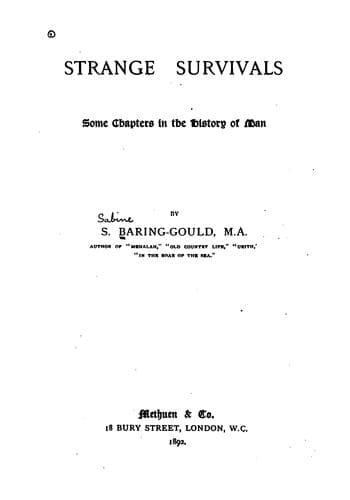
Strange Survivals: Some Chapters in the History of ManBaring-Gould, S. (Sabine)
History
Strange Survivals: Some Chapters in the History of Man
Baring-Gould, S. (Sabine)
Manners and customs -- Origin; Superstition
The story of the walls of Copenhagen comes to us only as a tradition,
but the horrible truth must be told that in all probability it is no
invention of the fancy, but a fact.
Throughout Norway, Sweden, Denmark, and North Germany, tradition
associates some animal with every church, and it goes by the name of
Kirk-Grim. These Kirk-Grims are the goblin apparitions of the beasts
that were buried under the foundation-stones of the churches. It is the
same in Devonshire--the writer will not say at the present day, but
certainly forty or fifty years ago. Indeed, when he was a boy he drew
up a list of the Kirk-Grims that haunted all the neighbouring parishes.
To the church of the parish in which he lived, belonged two white sows
yoked together with a silver chain; to another, a black dog; to a
third, a ghostly calf; to a fourth, a white lamb.
Afzelius, in his collection of Swedish folk-tales, says: “Heathen
superstition did not fail to show itself in the construction of
Christian churches. In laying the foundations, the people retained
something of their former religion, and sacrificed to their old
deities, whom they could not forget, some animal, which they buried
alive, either under the foundation or without the wall. The spectre of
this animal is said to wander about the churchyard at night, and is
called the Kirk-Grim. A tradition has also been preserved that under
the altar of the first Christian churches, a lamb was usually buried,
which imparted security and duration to the edifice. This is an emblem
of the true Church Lamb--the Saviour, who is the Corner-Stone of His
Church. When anyone enters a church at a time when there is no service,
he may chance to see a little lamb spring across the quire and vanish.
This is the church-lamb. When it appears to a person in the churchyard,
particularly to the grave-digger, it is said to forbode the death of a
child.”
Thiele, in his “Danish Folk-tales,” says much the same of the churches
in Denmark. He assures us that every church there has its Kirk-Grim,
which dwells either in the tower, or in some other place of concealment.
What lies at the base of all stories of haunted houses is the same
idea. All old mansions had their foundations laid in blood. This fact
is, indeed, forgotten, but it is not forgotten that a ghostly guard
watches the house, who is accounted for in various ways, and very often
a crime is attributed to one of the former inhabitants to account for
the walking of the ghost. By no means infrequently the crime, which,
in the popular mind, accounts for the ghost, can be demonstrated
historically not to have taken place. Again, in a great number of
cases, the spectre attached to a building is not that of a human being
at all, but of some animal, and then tradition is completely at a loss
to explain this phenomenon.
Public-domain text, read in full here on John Shaqi.
Reviews
Reviews
No reviews yet
Be the first to share your thoughts on this work.
Join the Discussion
Join the discussion
Sign in to leave a comment or review.
Sign InorCreate an account