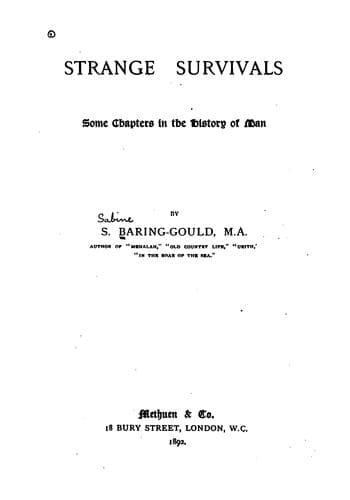
Strange Survivals: Some Chapters in the History of ManBaring-Gould, S. (Sabine)
History
Strange Survivals: Some Chapters in the History of Man
Baring-Gould, S. (Sabine)
Manners and customs -- Origin; Superstition
Here is a curious passage from an article on “The Production of Fire,”
in the _Penny Magazine_ for 26th July, 1834:--“The flint and steel,
with the tinder and match of some kind or other, have long been the
instruments of getting a light in the civilised world.... Within the
present century the aid of chemistry has been called in, ... and
instantaneous lights have become quite common, under the various names
of Promethians, Lucifers, etc., although, from its superior cheapness,
_the tinder-box will probably always keep its place in domestic use_.”
This article was published in the very year in which I was born, and
now it is extremely difficult to obtain an old tinder-box. I have
sought in the cottages and farmhouses in my own parish and those
adjoining, and have been unsuccessful in discovering more than one. A
generation has grown up that has never even heard of the tinder-box.
In or about 1673 phosphorus was discovered, and its easy ignition
by mere friction made known, and this opened the prospect of more
easy means of obtaining a light. But phosphorus was costly, and a
century and a half elapsed before the phosphorus match came into use.
Phosphoric tapers were employed; these were small wax tapers, the wicks
of which were coated with phosphorus; they were enclosed in glass tubes
hermetically sealed, and when a light was required, one end of the tube
was removed with a file, when the taper became ignited by exposure to
the air.
The plan was, however, clumsy, besides being dangerous and costly, and
never took hold of public estimation. The next attempt was to put a
piece of phosphorus into a small phial, and dissolve it at a moderate
heat, then keep the phial corked. The bottle was about the size of one
of smelling salts, and was kept at the head of the bed. When a light
was required, the glass stopper was removed, and a match coated with
sulphur was dipped into it, and worked about till a flame was produced,
when the match was withdrawn, and the phial hastily corked. Another
method was to rub the match, after dipping it in the bottle, against
a piece of cork or soft wood, the friction more certainly or less
dangerously promoting the combination of the sulphur and phosphorus,
and the consequent production of flame.
Another method of kindling a match was by means of Homberg’s
phosphorus, or fire-bearer. It was a black powder compound of flour,
sugar, and alum, which took fire on exposure to the air. But it never
came into general use. It remained in the hands of the curious. None of
these inventions displaced the old tinder-box, which maintained itself
to within the memory of many of us who are over fifty years.
Public-domain text, read in full here on John Shaqi.
Reviews
Reviews
No reviews yet
Be the first to share your thoughts on this work.
Elsewhere in the archive
Join the Discussion
Join the discussion
Sign in to leave a comment or review.
Sign InorCreate an account