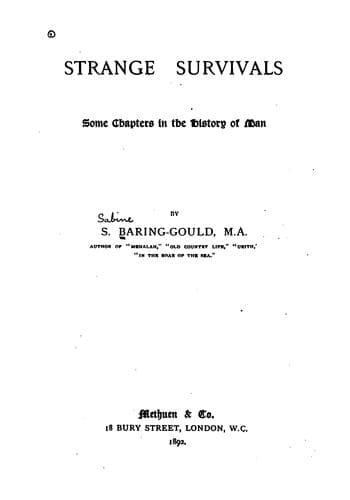
Strange Survivals: Some Chapters in the History of ManBaring-Gould, S. (Sabine)
History
Strange Survivals: Some Chapters in the History of Man
Baring-Gould, S. (Sabine)
Manners and customs -- Origin; Superstition
Of all the ingenious attempts to get rid of the tinder-box, the
oxymuriate matches were the most successful. From them our present
lucifers are lineally descended. The oxymuriate matches were composed
of chlorate of potash and sugar coating a strip of wood. The match was
dipped into a bottle containing a piece of asbestos soaked in oil of
vitriol. The bottle and a number of these matches, with tipped ends
downwards, were put into a neat little case, and this was called the
“phosphorus box.” On their first introduction, these boxes sold as high
as 15s. each; they gradually fell to 10s., then 5s., but never went
below half-a-crown. But they were not altogether successful. The oil of
vitriol lost its force after a while, owing to the readiness with which
it absorbed moisture from the air, and then the matches smouldered
instead of bursting into flame.
The next advance was the lucifer-match, with phosphorus and sulphur
combined at the end. But this was dangerous, and frightful accidents
attended the manufacture. I spent some winters at Pau, in the south
of France, and near our house were the cottages of poor people who
worked at match-making. The pans of melted phosphorus into which the
heads of the matches were dipped would explode suddenly, and scatter
their flaming contents over the match-girls. My mother, as an angel of
goodness, was wont to visit and minister to many and many a poor little
burnt girl, who had thus been set fire to.
But the phosphorus match-making had another objection to it, besides
the accidents produced in the melting of phosphorus. It brought on a
frightful disease in the jaw. The bone was attacked, and rotted away.
In the “Dublin Quarterly Journal of Medical Science” for 1852, the
nature of the disease is thus described:--“An affection ensues which is
so insidious in its nature that it is at first supposed to be common
toothache, and a most serious disease of the jaw is produced before
the patient is aware of his condition. The disease gradually creeps on
until the sufferer becomes a miserable and loathsome object, spending
the best period of his life in the wards of a public hospital. Many
patients have died of the disease; many unable to open their jaws have
lingered with carious and necrosed bones; others have suffered dreadful
mutilations from surgical operations, considering themselves happy to
escape with the loss of the greater portion of the lower jaw. In the
Museum of the Manchester Infirmary is the lower jaw of a young woman
who is now at work. Her face is much disfigured by the loss of her
chin, and, on looking into her mouth, the root of the tongue is seen
connected with her under lip, the space formerly occupied by the jaw
being obliterated by the contraction of the cheek.”
Thus, in the advance of civilisation, great agonies have been gone
through. Our present conveniences have been purchased at the cost of
throes and tears in the past. We should not forget that civilisation
has had its martyrs.
Public-domain text, read in full here on John Shaqi.
Reviews
Reviews
No reviews yet
Be the first to share your thoughts on this work.
Elsewhere in the archive
Join the Discussion
Join the discussion
Sign in to leave a comment or review.
Sign InorCreate an account