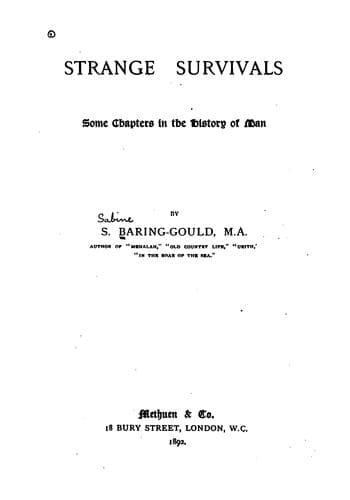
Strange Survivals: Some Chapters in the History of ManBaring-Gould, S. (Sabine)
History
Strange Survivals: Some Chapters in the History of Man
Baring-Gould, S. (Sabine)
Manners and customs -- Origin; Superstition
In the following ages we find exactly the same sort of scenes as
those that startled St. Paul at Corinth settling into an acknowledged
institution, and ending in such orgies, that the heathen were almost
justified in regarding Christianity as a religious nuisance, and a
danger to common morality. The accounts we have of the assemblies of
the followers of Valentine, Mark, Carpocrates, Epiphanes, and Isidore,
of the Ophites and Antitactites, present us with pictures of religious
revivals ending in the orgies of satyrs.
The empire, under Constantine, became Christian. Then the Church, no
longer persecuted, spread throughout the world with a definite creed,
an organised priesthood, a fixed mode of worship, and a rigid moral
code.
Then, as heretofore, in the early Church, in heathen Rome and Greece,
there were those unable to receive a religion so perfect or so
defined. They must have something vague and rudimentary, something
that did not require too much of them, that did not lay upon them too
many restrictions. These men sought what suited them in various forms
of heresy, or in the secret performance of Pagan rites, the heresies
all forms of negation, the Paganism altogether gross and elementary.
All these forms of revolt were reversions to the earliest protoplasmic
type. It is not my purpose to trace the history of these relapses
throughout the Middle Ages, for I am not writing a history of heresy;
my object is simply to note the fact that Spiritualism or Schamanism
constantly appears in the history of religion, varying its name but few
of its characteristics; sometimes becoming grossly immoral, sometimes
decent, but always whilst professing almost ascetic virtue with a
tendency to licentiousness.
As soon as Christianity became established, at once all the gods of
the heathen became devils, and their worship the worship of devils.
“Idolatry,” said Eusebius, in the _Præparatio Evangelica_, “does
not consist in the adoration of good spirits, but in that of those
which are evil and perverse.”[28] The Christian emperors forbade the
sacrifices to the gods, as sacrifices to devils. In 426, Theodosius
II. ordered every temple to be destroyed. Those who clung to the old
religion were driven to worship on mountains and in the depths of
forests. In 423, he had issued an injunction against the sacrifices, on
this very ground, that they were made to devils.
Public-domain text, read in full here on John Shaqi.
Reviews
Reviews
No reviews yet
Be the first to share your thoughts on this work.
Elsewhere in the archive
Join the Discussion
Join the discussion
Sign in to leave a comment or review.
Sign InorCreate an account