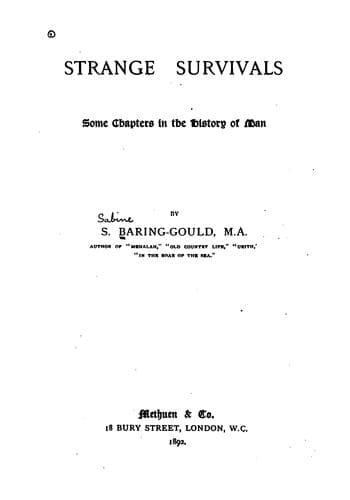
Strange Survivals: Some Chapters in the History of ManBaring-Gould, S. (Sabine)
History
Strange Survivals: Some Chapters in the History of Man
Baring-Gould, S. (Sabine)
Manners and customs -- Origin; Superstition
What took place in Italy or Greece, took place elsewhere in later
days, when the barbarians became Christians, or, at least, were made
nominal Christians, under Christian Frank emperors. The _Indiculus
superstitionum et Paganiarum_ of the Council of Leptines in Hainault,
in the eighth century, shows us Paganism completely converted into
witchcraft. Those who were addicted to it went to retired huts
(_casulæ_) in places formerly held sacred (_fana_); there they offered
sacrifices to Jupiter, Mercury, or some other god; they took auguries,
drew lots, called up spirits, made little images of linen and flour,
and carried them about the country, precisely as Sulpicius Severus
says was done by the Gauls in the time of St. Martin. Pope Gregory
III. condemned those who made sacrifices to fountains and trees, used
divinations, exercised magical rites, in honour of Belus and Janus,
“according to the customs of the Pagans,” and he anathematised all
those who took part in diabolical rites, and gave worship to devils.
Finally the Capitularies of Charles the Great and his successors armed
the secular power against all these remnants of idolatry.
At about the same period, the seventh century, Camin the Wise, Abbot of
Hy (Iona), tells us that the like superstitions prevailed in Ireland.
But, before this, the Council of Ancyra, in 341, had issued a decree,
which has, indeed, been called in question, but which was embodied
in the “Canon Episcopi,” by which the bishops were required to
exercise vigilant supervision over magical practices, and especially
to excommunicate certain impious females, who, blinded by the devil,
imagined themselves riding through the air in company with Hecate and
Herodias--Herodias is no other than Hruoda, a Lombard goddess, the
same as the Saxon Ostara.[29] The injunction was repeated by the Synod
of Agde, in 506, which, with other decrees of the sixth and seventh
centuries, represents witchcraft as a Pagan delusion. Magic and heresy
were one. Heresy was a turning away from the truth, and magic was its
ritual. Enmity to orthodoxy implied enmity to God, and enmity to God
alliance with the devil.
Public-domain text, read in full here on John Shaqi.
Reviews
Reviews
No reviews yet
Be the first to share your thoughts on this work.
Elsewhere in the archive
Join the Discussion
Join the discussion
Sign in to leave a comment or review.
Sign InorCreate an account