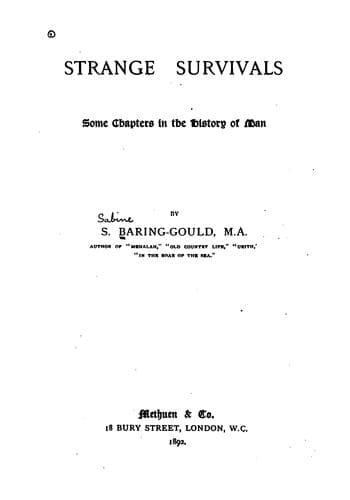
Strange Survivals: Some Chapters in the History of ManBaring-Gould, S. (Sabine)
History
Strange Survivals: Some Chapters in the History of Man
Baring-Gould, S. (Sabine)
Manners and customs -- Origin; Superstition
The “spiritually minded,” that is to say, the unintelligent,
hysterically disposed, did not at all relish the form given to belief,
and the discipline of Divine service framed by the Reformers. They
founded sects on all sides following the old lines of the Markosites
and Cathari.
Bishop Barlow, one of those who helped to draw up the English
Prayer-book, was himself an eye-witness of the proceedings of some of
these sects, and he describes them in words we do not care to quote.[30]
England, Germany, Switzerland, Scandinavia, were overrun with these
sectaries, with their love-feasts, raptures, and license. It was the
old story again of the revolt of the spiritual faculty against the
reason, a story that will be told over and over again as long as man
lives on the earth, and religion is dogmatic and exercises moral
restraint.
One essential condition was always present in order to produce its
effect in these sectarian meetings. The intellect must remain inactive,
the emotions must be excited, and the sentiment of vague fear must
be specially appealed to and powerfully wrought upon. It was this
condition which determined the success alike of the revivalist meetings
of the Mystics, and the revelries of the witches. This condition it was
that provoked the orgies at Corinth among St. Paul’s converts, and the
scenes in the assemblies of the Carpocratites. It was this condition
which roused the attendants on the assemblies of the Goeti, of the
Dionysian revellers, and of the Schamans and the medicine men.
These meetings always took place at night. There is reason to believe
that during each day there is a normal alteration in the functions
of the intellectual and emotional parts of the brain; that during
the sunlight the perceptive faculties and the reflective are chiefly
active; and that these, reposing during the night, permit the
feelings to be mostly dominant; and it is well-known that general and
simultaneous activity, both of the intellect and of the emotions, is
unnatural; that thought and feeling are antagonistic to each other.
Prayer meetings and witches’ assemblies alike began after dark and were
often continued till the small hours of the morning. Ignorant men and
women, and the youth of both sexes, were crowded together to partake
in some mysterious spiritual rite. The quiescence of the observant
and reflective faculties was facilitated, the imagination goaded
and stimulated until it conjured up conceptions of hell and visions
of devils with a vividness approaching reality; then came cries,
tremblings, fallings on the ground, and raptures.
Public-domain text, read in full here on John Shaqi.
Reviews
Reviews
No reviews yet
Be the first to share your thoughts on this work.
Elsewhere in the archive
Join the Discussion
Join the discussion
Sign in to leave a comment or review.
Sign InorCreate an account