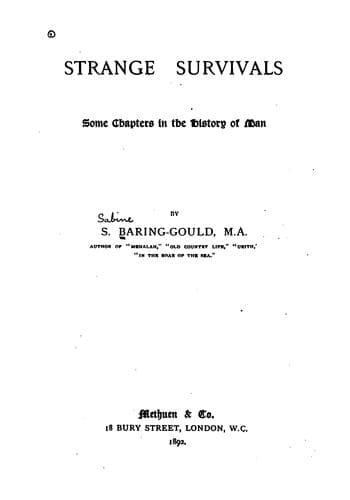
Strange Survivals: Some Chapters in the History of ManBaring-Gould, S. (Sabine)
History
Strange Survivals: Some Chapters in the History of Man
Baring-Gould, S. (Sabine)
Manners and customs -- Origin; Superstition
One may say boldly that Europe was half Pagan in the Middle Ages; all
the old superstitions lived, but under a new disguise. The religions
of Gaul, of Germany, of Great Britain, of the Scandinavian and the
Slavonic lands, the mythologies of Greece and of Rome, lived on in a
crowd of legends, which modern erudition delights in collecting and
tracing back to their sources. These legends, more numerous in the
lands occupied by Teutonic peoples, are almost always of Pagan stuff,
embroidered over with Christian ideas. Not only so, but the very names
of the old gods remain; they no longer remain as the names of gods held
high in heaven, but of devils cast down to earth. With us the Deuce
signifies Satan, and is in common usage in the mouth as an oath, but he
takes his name from the Dusii, the night genii of the Kelts. Old Nick
again is Hnikr, an honourable designation of Wuotan, the supreme god of
the Anglo-Saxons, who gives his name to Wednesday.
So, also, we use the word Bogie, Bogart, as a designation of an evil
spirit, and Bug is the name of a night-tormenting insect. It is
well-known that in an old English Bible the verse in Ps. xci. runs,
“He shall deliver thee from the Bug that walketh in darkness,” that
is, from the Hobgoblin. The Norsemen and Danes brought this name with
them to England. Bog is in Slavonic God. Biel-bog is the White God,
Czerni-bog is the Black God of the Slavs.
The Northmen had formerly come across Slavs on the Continent, and they,
the worshippers of Odin, scorned the gods of the Slavs as devils, and
called all unclean spirits--Bogs or Bogies. And now, also, the Supreme
God of the Norsemen, Hnikr, has become our Old Nick.
This being so, it will be seen at once how the votaries of the
dethroned god came to be regarded as devil-worshippers, and how
that in time, when the old religion with its myths and theogony was
long dead, those who still clung to an hysterical religion, with
love-feasts, dances, and ecstasies, came to believe themselves to be
devil-worshippers.
The Reformation caused such a disturbance of religious ideas, incited
to such revolt against all that had been held sacred in the past, that
it is only natural that those whose religion had been one of pure
spiritualism, of ecstasy and hysteric raving, should believe that their
day had come. But after the first explosion, the Reformers set to work
to consolidate their several systems into dogmatic shape; they drew up
Institutes, Confessions, Articles, and agreed only in this, to put down
Mysticism as severely as they had dealt with Catholicism. And they had
good cause to come to this resolution, for on all sides the Mystics
were breaking forth into the wildest excesses. In Münster they had set
up a Kingdom of Salem, from which every element of common decency was
expelled, and which knew no law save the revelations accorded to the
prophets.
Public-domain text, read in full here on John Shaqi.
Reviews
Reviews
No reviews yet
Be the first to share your thoughts on this work.
Elsewhere in the archive
Join the Discussion
Join the discussion
Sign in to leave a comment or review.
Sign InorCreate an account