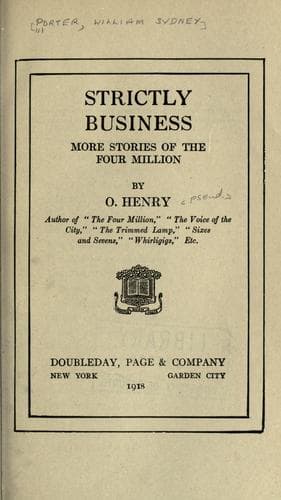
Strictly Business: More Stories of the Four MillionHenry, O.
Philosophy
Strictly Business: More Stories of the Four Million
Henry, O.
New York (N.Y.) -- Social life and customs -- Fiction
To be explicit, Annette McCorkle, the second housemaid who deserves a
paragraph herself. Annette Fletcherized large numbers of romantic
novels which she obtained at a free public library branch (donated by
one of the biggest caliphs in the business). She was Celia’s
side-kicker and chum, though Aunt Henrietta didn’t know it, you may
hazard a bean or two.
“Oh, canary-bird seed!” exclaimed Annette. “Ain’t it a corkin’
situation? You a heiress, and fallin’ in love with him on sight! He’s a
sweet boy, too, and above his business. But he ain’t susceptible like
the common run of grocer’s assistants. He never pays no attention to
me.”
“He will to me,” said Celia.
“Riches—” began Annette, unsheathing the not unjustifiable feminine
sting.
“Oh, you’re not so beautiful,” said Celia, with her wide, disarming
smile. “Neither am I; but he sha’n’t know that there’s any money mixed
up with my looks, such as they are. That’s fair. Now, I want you to
lend me one of your caps and an apron, Annette.”
“Oh, marshmallows!” cried Annette. “I see. Ain’t it lovely? It’s just
like ‘Lurline, the Left-Handed; or, A Buttonhole Maker’s Wrongs.’ I’ll
bet he’ll turn out to be a count.”
There was a long hallway (or “passageway,” as they call it in the land
of the Colonels) with one side latticed, running along the rear of the
house. The grocer’s young man went through this to deliver his goods.
One morning he passed a girl in there with shining eyes, sallow
complexion, and wide, smiling mouth, wearing a maid’s cap and apron.
But as he was cumbered with a basket of Early Drumhead lettuce and
Trophy tomatoes and three bunches of asparagus and six bottles of the
most expensive Queen olives, he saw no more than that she was one of
the maids.
But on his way out he came up behind her, and she was whistling
“Fisher’s Hornpipe” so loudly and clearly that all the piccolos in the
world should have disjointed themselves and crept into their cases for
shame.
The grocer’s young man stopped and pushed back his cap until it hung on
his collar button behind.
“That’s out o’ sight, Kid,” said he.
“My name is Celia, if you please,” said the whistler, dazzling him with
a three-inch smile.
“That’s all right. I’m Thomas McLeod. What part of the house do you
work in?”
“I’m the—the second parlor maid.”
“Do you know the ‘Falling Waters’?”
“No,” said Celia, “we don’t know anybody. We got rich too quick—that
is, Mr. Spraggins did.”
“I’ll make you acquainted,” said Thomas McLeod. “It’s a strathspey—the
first cousin to a hornpipe.”
If Celia’s whistling put the piccolos out of commission, Thomas
McLeod’s surely made the biggest flutes hunt their holes. He could
actually whistle _bass_.
When he stopped Celia was ready to jump into his delivery wagon and
ride with him clear to the end of the pier and on to the ferry-boat of
the Charon line.
“I’ll be around to-morrow at 10:15,” said Thomas, “with some spinach
and a case of carbonic.”
Public-domain text, read in full here on John Shaqi.
Reviews
Reviews
No reviews yet
Be the first to share your thoughts on this work.
Elsewhere in the archive
Join the Discussion
Join the discussion
Sign in to leave a comment or review.
Sign InorCreate an account