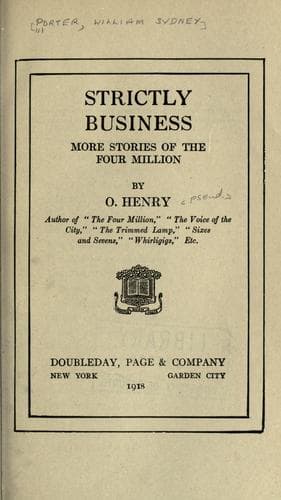
Strictly Business: More Stories of the Four MillionHenry, O.
Philosophy
Strictly Business: More Stories of the Four Million
Henry, O.
New York (N.Y.) -- Social life and customs -- Fiction
“I’ll practice that what-you-may-call-it,” said Celia. “I can whistle a
fine second.”
The processes of courtship are personal, and do not belong to general
literature. They should be chronicled in detail only in advertisements
of iron tonics and in the secret by-laws of the Woman’s Auxiliary of
the Ancient Order of the Rat Trap. But genteel writing may contain a
description of certain stages of its progress without intruding upon
the province of the X-ray or of park policemen.
A day came when Thomas McLeod and Celia lingered at the end of the
latticed “passage.”
“Sixteen a week isn’t much,” said Thomas, letting his cap rest on his
shoulder blades.
Celia looked through the lattice-work and whistled a dead march.
Shopping with Aunt Henrietta the day before, she had paid that much for
a dozen handkerchiefs.
“Maybe I’ll get a raise next month,” said Thomas. “I’ll be around
to-morrow at the same time with a bag of flour and the laundry soap.”
“All right,” said Celia. “Annette’s married cousin pays only $20 a
month for a flat in the Bronx.”
Never for a moment did she count on the Spraggins money. She knew Aunt
Henrietta’s invincible pride of caste and pa’s mightiness as a Colossus
of cash, and she understood that if she chose Thomas she and her
grocer’s young man might go whistle for a living.
Another day came, Thomas violating the dignity of Nabob Avenue with
“The Devil’s Dream,” whistled keenly between his teeth.
“Raised to eighteen a week yesterday,” he said. “Been pricing flats
around Morningside. You want to start untying those apron strings and
unpinning that cap, old girl.”
“Oh, Tommy!” said Celia, with her broadest smile. “Won’t that be
enough? I got Betty to show me how to make a cottage pudding. I guess
we could call it a flat pudding if we wanted to.”
“And tell no lie,” said Thomas.
“And I can sweep and polish and dust—of course, a parlor maid learns
that. And we could whistle duets of evenings.”
“The old man said he’d raise me to twenty at Christmas if Bryan
couldn’t think of any harder name to call a Republican than a
‘postponer,’” said the grocer’s young man.
“I can sew,” said Celia; “and I know that you must make the gas
company’s man show his badge when he comes to look at the meter; and I
know how to put up quince jam and window curtains.”
“Bully! you’re all right, Cele. Yes, I believe we can pull it off on
eighteen.”
As he was jumping into the wagon the second parlor maid braved
discovery by running swiftly to the gate.
“And, oh, Tommy, I forgot,” she called, softly. “I believe I could make
your neckties.”
“Forget it,” said Thomas decisively.
“And another thing,” she continued. “Sliced cucumbers at night will
drive away cockroaches.”
“And sleep, too, you bet,” said Mr. McLeod. “Yes, I believe if I have a
delivery to make on the West Side this afternoon I’ll look in at a
furniture store I know over there.”
Public-domain text, read in full here on John Shaqi.
Reviews
Reviews
No reviews yet
Be the first to share your thoughts on this work.
Elsewhere in the archive
Join the Discussion
Join the discussion
Sign in to leave a comment or review.
Sign InorCreate an account