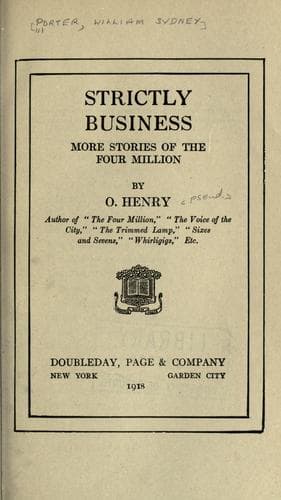
Strictly Business: More Stories of the Four MillionHenry, O.
Philosophy
Strictly Business: More Stories of the Four Million
Henry, O.
New York (N.Y.) -- Social life and customs -- Fiction
Forster got his straw hat (straws will be in and maybe out again long
before this is printed) from the checkroom boy, and walked out of the
air (as Hamlet says). Billinger was used to having his stories insulted
and would not mind. Forster was in his favorite mood and wanted to go
away from anywhere. A man, in order to get on good terms with himself,
must have his opinions corroborated and his moods matched by some one
else. (I had written that “somebody”; but an A. D. T. boy who once took
a telegram for me pointed out that I could save money by using the
compound word. This is a vice versa case.)
Forster’s favorite mood was that of greatly desiring to be a follower
of Chance. He was a Venturer by nature, but convention, birth,
tradition and the narrowing influences of the tribe of Manhattan had
denied him full privilege. He had trodden all the main-traveled
thoroughfares and many of the side roads that are supposed to relieve
the tedium of life. But none had sufficed. The reason was that he knew
what was to be found at the end of every street. He knew from
experience and logic almost precisely to what end each digression from
routine must lead. He found a depressing monotony in all the variations
that the music of his sphere had grafted upon the tune of life. He had
not learned that, although the world was made round, the circle has
been squared, and that it’s true interest is to be in “What’s Around
the Corner.”
Forster walked abroad aimlessly from the Powhatan, trying not to tax
either his judgment or his desire as to what streets he traveled. He
would have been glad to lose his way if it were possible; but he had no
hope of that. Adventure and Fortune move at your beck and call in the
Greater City; but Chance is oriental. She is a veiled lady in a sedan
chair, protected by a special traffic squad of dragonians. Crosstown,
uptown, and downtown you may move without seeing her.
At the end of an hour’s stroll, Forster stood on a corner of a broad,
smooth avenue, looking disconsolately across it at a picturesque old
hotel softly but brilliantly lit. Disconsolately, because he knew that
he must dine; and dining in that hotel was no venture. It was one of
his favorite caravansaries, and so silent and swift would be the
service and so delicately choice the food, that he regretted the hunger
that must be appeased by the “dead perfection” of the place’s cuisine.
Even the music there seemed to be always playing _da capo_.
Public-domain text, read in full here on John Shaqi.
Reviews
Reviews
No reviews yet
Be the first to share your thoughts on this work.
Elsewhere in the archive
Join the Discussion
Join the discussion
Sign in to leave a comment or review.
Sign InorCreate an account