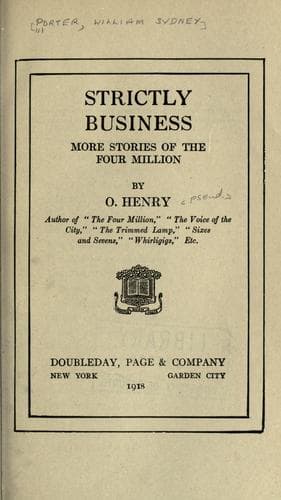
Strictly Business: More Stories of the Four MillionHenry, O.
Philosophy
Strictly Business: More Stories of the Four Million
Henry, O.
New York (N.Y.) -- Social life and customs -- Fiction
“Why, no,” said I, after some reflection; “I don’t see my way clear to
making a complaint. But I would like to place myself on record as
asserting that I do not care for his company. Your town,” I continued,
“seems to be a quiet one. What manner of entertainment, adventure, or
excitement have you to offer to the stranger within your gates?”
“Well, sir,” said the clerk, “there will be a show here next Thursday.
It is—I’ll look it up and have the announcement sent up to your room
with the ice water. Good night.”
After I went up to my room I looked out the window. It was only about
ten o’clock, but I looked upon a silent town. The drizzle continued,
spangled with dim lights, as far apart as currants in a cake sold at
the Ladies’ Exchange.
“A quiet place,” I said to myself, as my first shoe struck the ceiling
of the occupant of the room beneath mine. “Nothing of the life here
that gives color and variety to the cities in the East and West. Just a
good, ordinary, humdrum, business town.”
Nashville occupies a foremost place among the manufacturing centres of
the country. It is the fifth boot and shoe market in the United
States, the largest candy and cracker manufacturing city in the South,
and does an enormous wholesale drygoods, grocery, and drug business.
I must tell you how I came to be in Nashville, and I assure you the
digression brings as much tedium to me as it does to you. I was
traveling elsewhere on my own business, but I had a commission from a
Northern literary magazine to stop over there and establish a personal
connection between the publication and one of its contributors, Azalea
Adair.
Adair (there was no clue to the personality except the handwriting) had
sent in some essays (lost art!) and poems that had made the editors
swear approvingly over their one o’clock luncheon. So they had
commissioned me to round up said Adair and corner by contract his or
her output at two cents a word before some other publisher offered her
ten or twenty.
At nine o’clock the next morning, after my chicken livers _en
brochette_ (try them if you can find that hotel), I strayed out into
the drizzle, which was still on for an unlimited run. At the first
corner I came upon Uncle Cæsar. He was a stalwart Negro, older than the
pyramids, with gray wool and a face that reminded me of Brutus, and a
second afterwards of the late King Cettiwayo. He wore the most
remarkable coat that I ever had seen or expect to see. It reached to
his ankles and had once been a Confederate gray in colors. But rain and
sun and age had so variegated it that Joseph’s coat, beside it, would
have faded to a pale monochrome. I must linger with that coat, for it
has to do with the story—the story that is so long in coming, because
you can hardly expect anything to happen in Nashville.
Public-domain text, read in full here on John Shaqi.
Reviews
Reviews
No reviews yet
Be the first to share your thoughts on this work.
Elsewhere in the archive
Join the Discussion
Join the discussion
Sign in to leave a comment or review.
Sign InorCreate an account