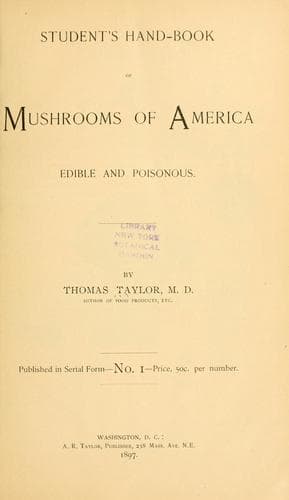
Student's Hand-book of Mushrooms of America, Edible and PoisonousTaylor, Thomas
Science
Student's Hand-book of Mushrooms of America, Edible and Poisonous
Taylor, Thomas
Mushrooms -- United States; Pathogenic fungi
The plants of this species vary very much in size and in the color of
the cap. The latter is sometimes a bright scarlet and again it is orange
color, more frequently ochraceous yellow, fading to a very pale yellow
tint. In the variety _albus_ it is white. The stem is stuffed with webby
fibrils and varies very much in thickness: sometimes in young specimens
it is very stout, with a thick ovate bulb reaching well up towards the
cap, and again it is comparatively slender and nearly equal from the cap
down to a very slight bulb at the base. The very young plant is
completely enveloped in a white or yellowish egg-shaped wrapper or
volva, which, being friable, generally breaks up into scales, forming
warts upon the upper surface of the cap. When the plant is young and
moist the cap is slightly sticky. A thickish white veil extends from the
stem to the inner margin of the cap. This breaks away with the growth
and expansion of the plant and falls in lax folds, forming a deflexed
ring round the upper portion of the stem.
This mushroom is very common in woods and forests in summer and autumn,
and has a wide geographical range. It is recorded by all mycologists as
poisonous. One author states that when eaten in very small quantities it
acts as a cathartic, but that it causes death when eaten freely. Flies
find in it a deadly poison, and the poisonous alkaloids are not
destroyed by drying.
Although cases are cited where this mushroom has been eaten without
injury, its fatally poisonous effects have been too well and too often
tested to allow of any doubt as to the danger of eating it, even in
small quantities.
Amanita Frostiana, Frost's Amanita, is a much smaller species than A.
muscaria. It bears a very close resemblance to the Fly Amanita, and
might easily be taken for a small form of the same. The cap is yellowish
and warted, and specimens occur in which the stem and gills are slightly
tinged with yellow. It is poisonous.
PLATE XV.
FIG. 8.--=Ag. (Amanita) phalloides= Fries (=Amanita phalloides=)
=A. vernalis= Bolt., =A. verrucosus= Curtis. "_Poisonous Amanita_,"
"_Death Cup_."
POISONOUS.
Public-domain text, read in full here on John Shaqi.
Reviews
Reviews
No reviews yet
Be the first to share your thoughts on this work.
Elsewhere in the archive
Join the Discussion
Join the discussion
Sign in to leave a comment or review.
Sign InorCreate an account